
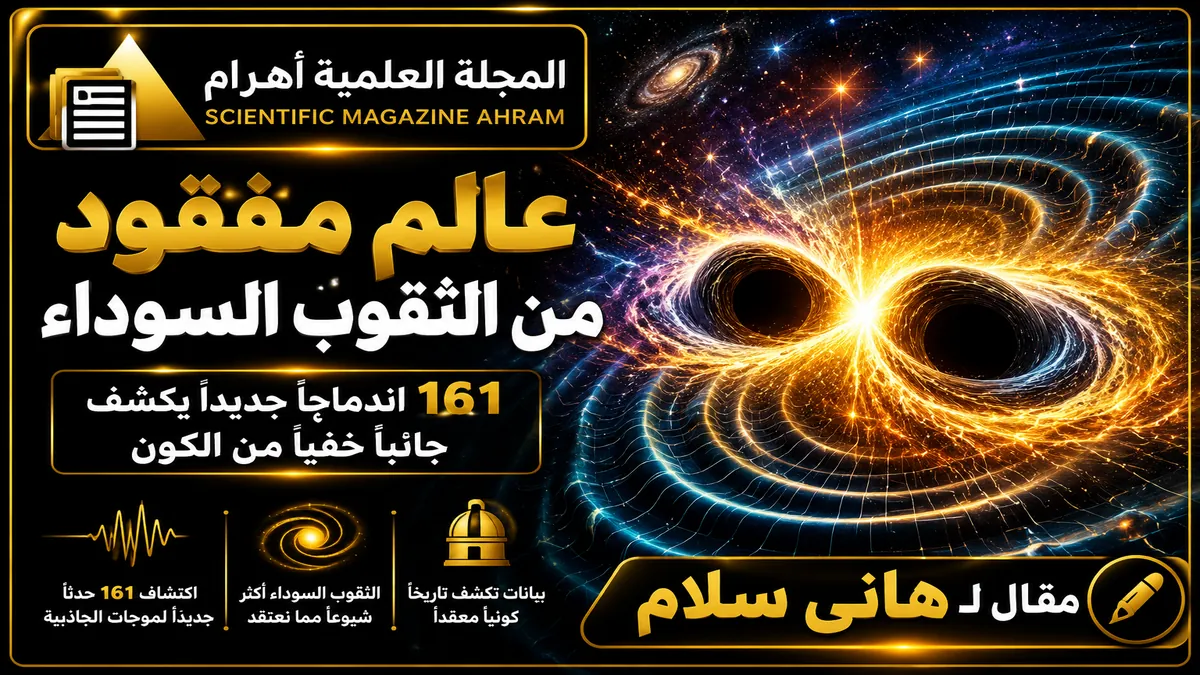

In a new milestone for modern astronomy, researchers have announced the discovery of a “lost world” of black holes after analyzing massive amounts of data collected by gravitational wave observatories in recent years.
The new scientific catalog reveals 161 additional black hole merger events, bringing the total number of observed events to hundreds. As a result, scientists have gained a clearer picture of one of the most mysterious objects in the universe.
This discovery does not just mean finding new black holes; it also uncovers a complex cosmic history spanning billions of years.
How Did Scientists Discover These Black Holes?
Black holes cannot be seen directly because they do not emit light that conventional telescopes can capture.
Therefore, scientists rely on a different technique known as gravitational waves. These are ripples in the fabric of spacetime generated when extremely massive objects collide with each other.
When two black holes merge, they release a tremendous amount of energy in the form of gravitational waves that propagate across the universe at immense speeds.
Specialized observatories catch these subtle signals, allowing researchers to study events that took place billions of light-years away.
A World Not Seen Before
The new data show that black hole mergers are more common than previously thought.
They also reveal the presence of black holes formed as a result of previous mergers that later took part in new ones.
For this reason, some researchers compare the finding to discovering a lost civilization that remained hidden from view for a long time.
Instead of observing isolated events, scientists are beginning to see a complex network of cosmic interactions spanning vast periods of time.
Why Is This Discovery Important?
The new catalog helps scientists understand how black holes form and grow over time.
It also contributes to testing some fundamental theories in physics, including Albert Einstein’s theory of general relativity.
Furthermore, these data may help unlock the secrets of the evolution of galaxies and giant stars whose lives end in the formation of black holes.
What Do Gravitational Waves Teach Us?
Just a few years ago, scientists relied on light to observe most cosmic phenomena.
Today, it has become possible to “listen” to the universe via gravitational waves.
Thanks to this new technique, researchers are able to study events that were entirely invisible in the past.
That is why some scientists describe the era of gravitational waves as the beginning of a new chapter in the history of astronomy.
The Universe Still Hides Much
Despite this major achievement, researchers note that what has been discovered so far may represent only a small fraction of the number of black holes in the universe.
As the sensitivity of observatories improves in the coming years, scientists expect to discover thousands of new events.
This could reshape our understanding of the history of the universe and its evolution since its earliest origins.
Every new signal captured by gravitational wave observatories may reveal another aspect of this hidden world that has remained out of human sight for billions of years.
Hany Sallam


Latest video
تابع معنا تحليل قراءة الصحف اليومية مع الكاتب الصحفي Hany Sallam عبر