

Journey to the Dark Side: The Mystery of the Solar Wind
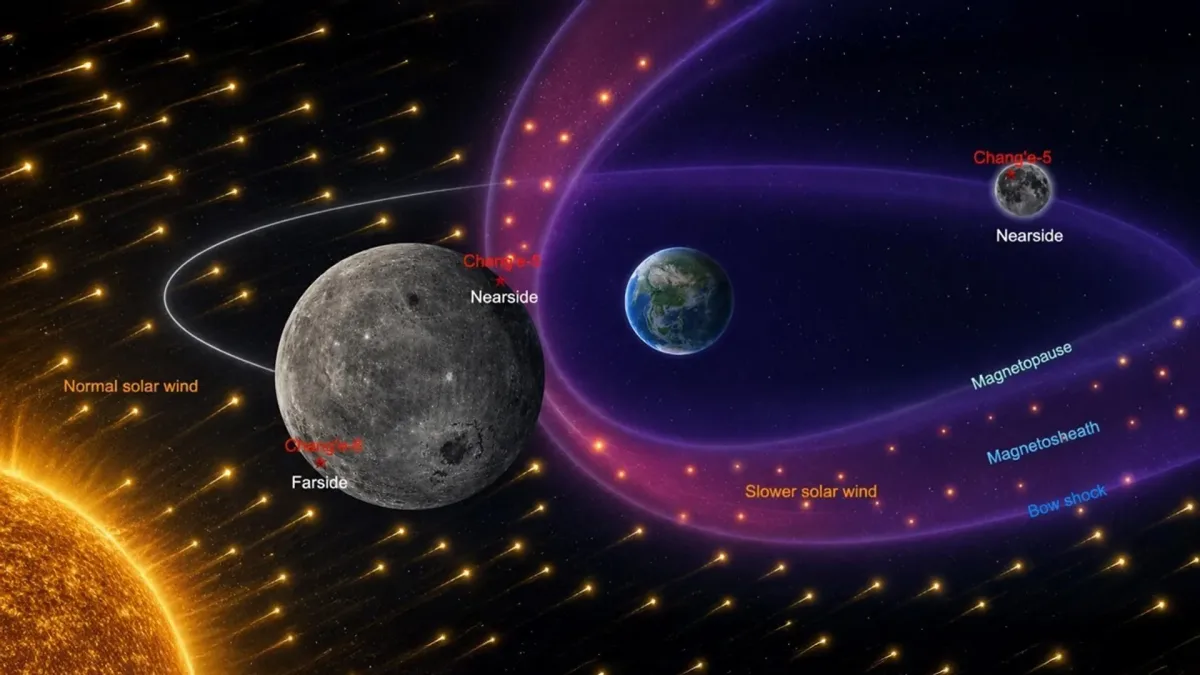
Humans have always looked at the Moon with admiration, but we have grown accustomed to seeing only one side of it. Now, thanks to the historic mission of China’s Chang’e-6 probe, we are beginning to realize that the far side of the Moon is not merely a silent region, but a cosmic record holding staggering secrets about the history of our relationship with the Sun. Samples collected from this side have revealed a drastic contrast in how the two lunar hemispheres receive strikes from the solar wind, changing our understanding of our space environment.
Earth’s Hidden Shield
The scientific surprise is that the near side of the Moon, which faces Earth, enjoys “partial protection.” The solar wind, a continuous stream of high-energy charged particles, does not reach this side at full strength; Earth’s magnetic field acts as a giant shield that impedes the path of these particles and reduces their speed and impact. In contrast, the far side of the Moon remains exposed to direct and unfiltered bombardment from these harsh winds, leading to chemical and physical reactions in its soil that differ completely from those on the near side.
Secrets of the Noble Gases
How did scientists figure out this contrast? The secret lies in “noble gases” trapped inside grains of lunar soil (regolith). These gases act as time capsules, preserving the fingerprint of the solar wind that has collided with the lunar surface over millions of years. By analyzing these samples, scientists were able to determine the depth to which the particles penetrated the soil, discovering that ion bombardment on the far side was much more intense and deep-seated than on the near side.
A Window into Earth’s Past
The significance of these findings does not stop at understanding the nature of the Moon; rather, it extends to serving as a mirror for the history of our planet. Studying how these impressions on the lunar surface change allows scientists to reconstruct the history of Earth’s magnetosphere. By reading the solar wind records preserved in lunar rocks, we can learn how Earth’s magnetic shield performed in bygone eras and how it evolved to provide us with a safe environment that allowed life to emerge and flourish. In this sense, the Moon is not merely a rocky neighbor, but a space archive that tells us how we survived the Sun’s wrath across the ages.
By: Hany Sallam
Source: ScienceDaily


Latest video
تابع معنا تحليل قراءة الصحف اليومية مع الكاتب الصحفي Hany Sallam عبر