


Discovery Threatens Earth: NASA Detects Methane Emissions from Dozens of Sites on Earth
Follow-up / Eng. Reham Adel Kamal Chemical Engineer
In a breakthrough scientists hope will help curb emissions of methane—a major contributor to climate warming—a new NASA space mission has revealed dozens of locations responsible for super-emissions of the gas. These emissions are generally linked to fossil fuel production sites, waste management facilities, or even agricultural sectors.
New NASA Tool to Monitor Super Methane Emission Sites from Space:
The EMIT space mission was launched in July and installed on the International Space Station, with the initial aim of monitoring how airborne mineral dust movements affect the climate.
However, the instrument has also proven useful for another critical task, detecting more than 50 sites releasing super-emission levels in Central Asia, the Middle East, and the southwestern United States since its installation in July aboard the International Space Station.
The device was also originally designed to advance studies of airborne dust and its impacts on climate change, and NASA noted that EMIT is “the first of a new class of Earth-monitoring imaging spectrometers.”
Methane absorbs infrared light in a unique way that the instrument can easily detect, according to scientists at NASA’s Jet Propulsion Laboratory near Los Angeles, where the device was designed and built.
NASA Administrator Bill Nelson stated that this capability “will not only help scientists better identify where methane leaks are coming from, but also help them understand how to address them quickly.”
Andrew Thorpe of NASA’s Jet Propulsion Laboratory explained in a statement that some of the emission plumes detected were “among the largest of their kind ever seen.” He added that “what we found in such a short time has surpassed anything we could have imagined.”
Statement from NASA’s Jet Propulsion Laboratory:
- In Turkmenistan, the instrument identified a dozen emission plumes originating from oil and gas infrastructure facilities east of the coastal city of Hazar, with some of these westward-spreading plumes stretching for 32 kilometers.
- In the US state of New Mexico, another emission plume nearly 3.3 kilometers long was discovered in one of the world’s largest oil fields.
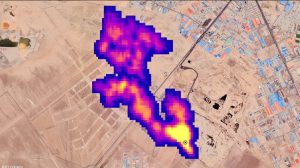
- In Iran, south of Tehran, a plume measuring at least 4.8 kilometers long was observed originating from a waste management complex.
Scientists estimate that these three sites release 50,400, 18,300, and 8,500 kilograms of methane per hour, respectively.

Methane Is Attributed with Responsibility for About 30% of Climate Warming:
Although it remains in the atmosphere for a much shorter time than carbon dioxide, its warming potential is 80 times higher than that of carbon dioxide over a 20-year period.
References:


Latest video
تابع معنا تحليل قراءة الصحف اليومية مع الكاتب الصحفي Hany Sallam عبر