

The Dust Challenge: The Hidden Enemy on the Lunar Surface
As humanity prepares for a historic new step toward the Moon through the Artemis program, NASA engineers face a challenge that appears simple on the surface but is lethal in its core: lunar dust
. Unlike the sand we know on Earth, lunar dust has a unique nature. It is as sharp as glass, electrically charged, and highly adhesive, making it a serious hazard that threatens the safety of spacesuits, technical equipment, and even the health of astronauts.
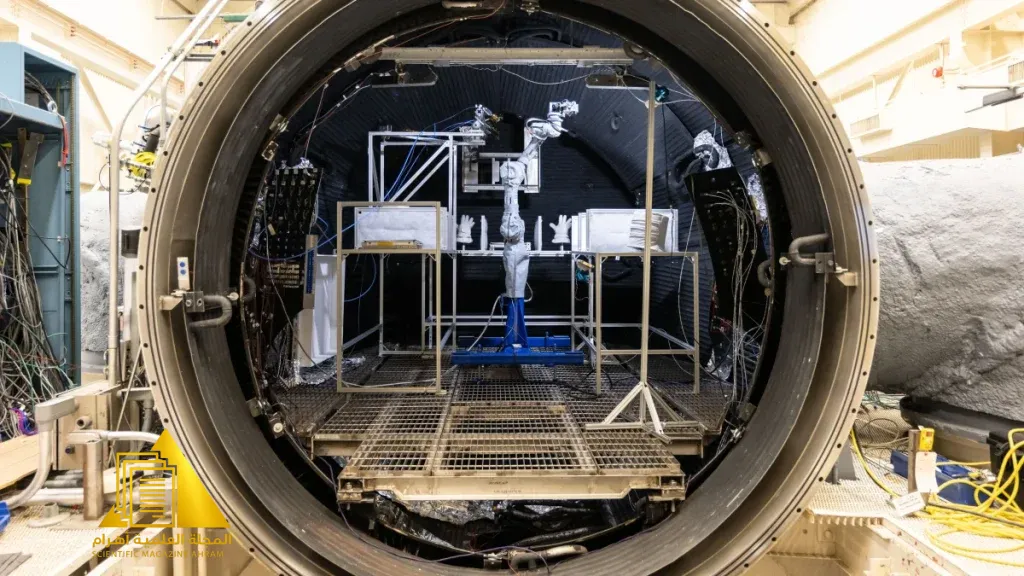
Johnson Laboratories: The Harsh Testing Ground
At the heart of the Johnson Space Center in Houston, NASA has established an advanced facility dedicated to simulating the harsh lunar environment. Here, the technology that astronauts will rely on is subjected to rigorous endurance testing. The goal is not merely to verify the efficiency of the devices, but to ensure their ability to withstand the erosion caused by this dust, which can penetrate the delicate mechanical joints of equipment and damage the vital systems of lunar landers.
Protecting the Future: Why Do We Care About Dust?
Understanding the behavior of lunar dust is the key to the continuity of long human missions. Engineers are studying how dust particles interact with different materials, trying to devise defensive solutions, such as non-stick coatings and self-cleaning technologies for spacesuits. The success of these tests in Earth laboratories is the real guarantee that Artemis missions will remain safe and effective when they land on the mysterious silver dust.
Toward Sustainable Exploration
These efforts do not stop at protecting equipment, but extend to being part of a strategy for future lunar colonization. If we want to build sustainable human bases on the Moon, we must learn how to live and coexist with this hostile dust. Those precise experiments in the laboratory today are what will pave the way for astronauts to walk with confidence and safety on the surface of our celestial neighbor, turning scientific challenges into achievements that serve humanity’s future in space.
By: Hany Sallam
Source: NASA


Latest video
تابع معنا تحليل قراءة الصحف اليومية مع الكاتب الصحفي Hany Sallam عبر