
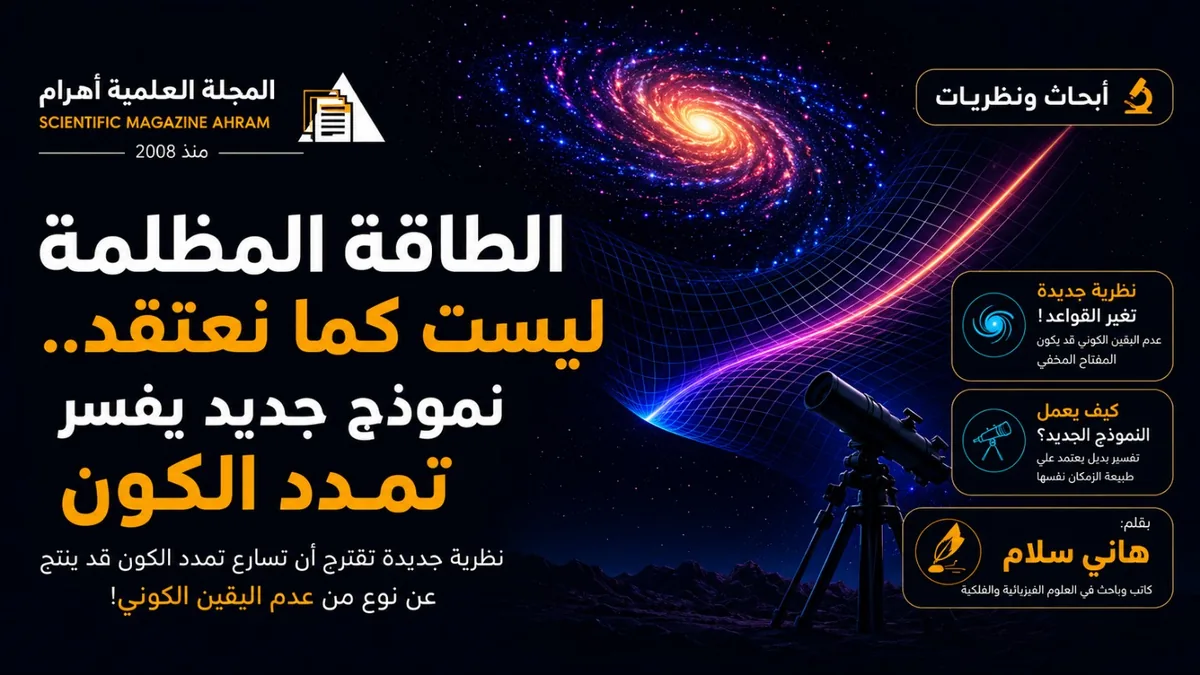

For more than 25 years, scientists have believed that the universe is expanding at an accelerating pace because of a mysterious force they call “dark energy.” But a new theoretical study offers a completely different, and perhaps even stranger, possibility.
Instead of a hidden energy pushing the universe outward, researchers suggest that the real cause may be linked to the fabric of spacetime itself, and to a new type of cosmic uncertainty resembling Heisenberg’s famous principle in the quantum world.
What Is Dark Energy?
The idea of dark energy emerged in 1998 when astronomers discovered that the expansion of the universe was not slowing down as expected.
On the contrary, it seemed to be accelerating over time.
Because no one knew the real reason for this acceleration, scientists proposed the existence of an unknown form of energy filling the universe and pushing galaxies away from one another.
Since that time, dark energy has become an essential part of the modern cosmological model.
A New Idea That May Change the Whole Picture
The new study suggests that the universe may not need dark energy at all.
Researchers propose that a kind of “cosmic fuzziness” may affect the way the universe expands.
The idea is similar to the uncertainty principle in quantum mechanics, which states that certain physical properties cannot be known with absolute precision at the same time.
However, the new model applies a similar concept to the entire universe.
How Does This Model Work?
According to the researchers, there may be a natural limit preventing measurements of the size of the universe and its expansion rate with complete precision simultaneously.
This constraint leads to a modification of the traditional equations describing cosmic expansion.
When these new effects are added to the calculations, a behavior resembling the effect of dark energy appears without the need to assume the existence of a new, mysterious energy.
In other words, cosmic acceleration may be the result of the nature of spacetime itself, rather than an unknown force filling the universe.
Why Does This Idea Interest Scientists?
The importance of the idea lies in its attempt to solve two major problems in modern cosmology.
The first is the puzzling explanation for dark energy.
The second is the “Hubble tension,” which is the ongoing disagreement among methods for measuring the expansion rate of the universe.
The authors of the study believe that the new model may help explain both phenomena within a single theoretical framework.
Can the Theory Be Tested?
So far, the idea remains entirely theoretical.
However, researchers emphasize that modern astronomical observatories may be able to test some predictions of the new model in the coming years.
These projects include massive observatories such as DESI, the European Euclid mission, and the American Vera C. Rubin Observatory.
If these instruments detect subtle deviations from the traditional cosmological model, the new idea may gain more serious consideration within the scientific community.
Are We Getting Closer to Solving the Biggest Mystery in the Universe?
To this day, scientists do not know what dark energy truly is.
Although the new model does not provide a definitive answer, it opens a different door to understanding the universe.
Dark energy may not be a hidden substance or force as we have imagined for decades.
Instead, the true secret may be hidden within the deep laws governing spacetime itself.
Like many major ideas in physics, the matter may begin with a new mathematical equation and later transform into a discovery that changes our understanding of the entire universe.
Hany Sallam


Latest video
تابع معنا تحليل قراءة الصحف اليومية مع الكاتب الصحفي Hany Sallam عبر