


Researchers at Ames National Laboratory, Iowa State University, the University of Virginia, and Columbia University have developed a new hybrid catalyst that converts carbon dioxide into sustainable ethylene in a single vessel.
This catalyst supports the global net-zero carbon initiative by using CO2 as a feedstock to produce electricity-powered, efficient ethylene.
Ethylene is a chemical used to manufacture a wide range of products, from plastics to antifreeze.
Large-scale ethylene production is energy-intensive and relies heavily on fossil resources.
“Electrocatalytic production of ethylene from carbon dioxide is emerging as a promising method.”
- The New Catalyst (NAC):
This new catalyst consists solely of earth-abundant materials, such as nickel and copper, and requires less energy for the chemical reaction.
- How the Catalyst (NAC) Works:
- Long Qi, a scientist at Ames Laboratory, explained: that atomically dispersed nickel anchored on nitrogen-coordinated carbon (NAC) acts as an initial catalyst to drive carbon dioxide (CO2) reduction at low voltage and high current.
- The catalyst was found to be effective across a wide range of electrical potentials, and its performance at high currents means a high carbon dioxide conversion rate.
- Long Qi said:
“Because this catalyst remains active across a very wide voltage range, it allows for easy pairing with a second catalyst.”
“Therefore, we use a second catalyst, which is copper nanowires, and by combining the two, we have a highly selective process with up to 60% efficiency for converting carbon dioxide to ethylene in a single vessel.”
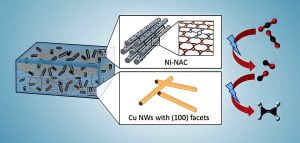
As shown in the image: The Structure of the Catalyst for Ethylene Production:
- On the left: An image of the composite catalyst.
- Top center: This image shows the porous structure of the Ni-NAC side of the composite catalyst. Light blue represents atomically dispersed nickel, blue represents nitrogen, and red represents carbon within the framework.
- Bottom center: This is a visualization of the copper nanowires.
- On the right: This illustrates the catalytic reduction of carbon dioxide at Ni-NAC atoms through the application of an electrical charge, after which further electrical input drives the carbon dioxide reaction to produce ethylene.
Wenyu Huang, an Ames Laboratory scientist and Iowa State University professor, noted:
- That the porous structure of the catalyst enhances its effectiveness.
- Saying “our catalyst has an ordered porous structure that benefits from mass transport”. “Because it is highly porous, you have a very high surface area to expose a lot of active nickel sites, making our catalyst extremely effective at reducing carbon dioxide.”
“The most exciting aspect of this research was how the team combined the two catalysts to simplify the process. We essentially combine the two best standalone catalysts, and they work together so that we can couple carbon dioxide to ethylene reactions in a single system,” he said.
Scientist Qi pointed to the importance of using carbon dioxide as a feedstock for this reaction, as it addresses the global need to reduce the amount of carbon dioxide released into the atmosphere. He explained that this process can utilize carbon dioxide recovered from chemical or industrial processes, or from air capture.
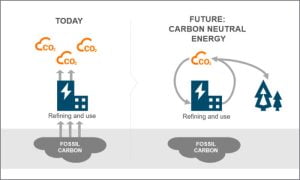
Qi, a scientist on the laboratory team, said: “We can do this without any precious metals, simply using nickel, copper, carbon, and nitrogen, to enable large-scale industrial applications. Also, we may potentially eliminate the use of fossil resources to make ethylene in the future.”
References:
- https://energy.gov/science
- https://www.sciencedaily.com/releases/2023/01/2301271
- Journal of the American Chemical Society, 2022; 144 (45):
20931DOI: 10.1021/jacs.2c09773
- https://www.ameslab.gov


Latest video
تابع معنا تحليل قراءة الصحف اليومية مع الكاتب الصحفي Hany Sallam عبر