

A New Technological Window Reveals the Secrets of the Universe
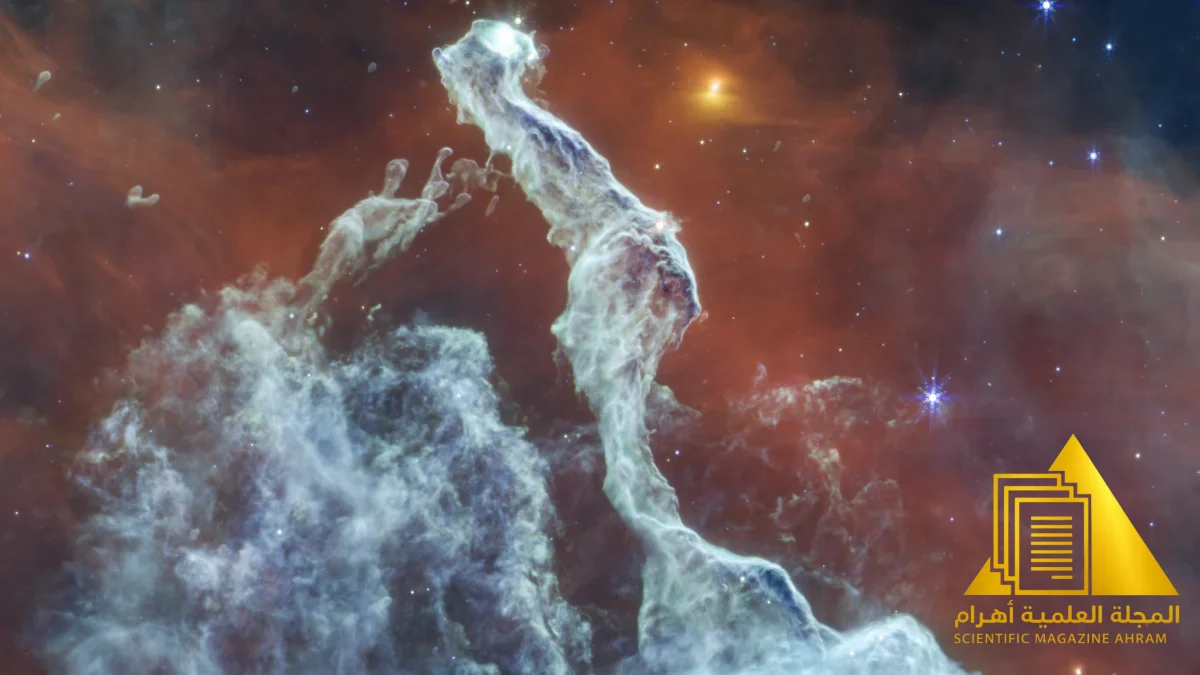
In a fresh astronomical achievement added to a record of dazzling discoveries, the James Webb Space Telescope has turned its advanced lenses toward one of the most compelling and curious celestial objects: the Cat’s Paw Nebula. This new image, captured in the mid-infrared range, gives scientists an unprecedented opportunity to delve into intricate, precise details that were previously invisible, opening a new horizon for understanding the mechanisms that shape the fabric of our galaxy.
How Did the Celestial Masterpiece of the Cat’s Paw Form?
This nebula features a unique shape that gives it the name “Cat’s Paw,” and it is believed that this distinctive form did not arise from nowhere, but is the product of a conflict and cosmic processes spanning millions of years. Initial scientific analyses indicate that intense ultraviolet radiation and fierce winds emitted from massive neighboring stars in the Carina Nebula acted as a skilled sculptor, carving and shaping these complex structures over time through continuous interaction between stellar winds and surrounding gases.
This stellar feedback represents a fundamental engine for space dynamics, as it directly affects the life cycle of stars and the distribution of matter in the universe. As the analysis of data provided by the James Webb Space Telescope continues, scientists are coming a step closer to uncovering complex cosmic mysteries, turning astronomical awe and beauty into detailed scientific maps that enrich our knowledge of the origin and evolution of the universe.
By: Hany Sallam
Source: NASA


Latest video
تابع معنا تحليل قراءة الصحف اليومية مع الكاتب الصحفي Hany Sallam عبر