
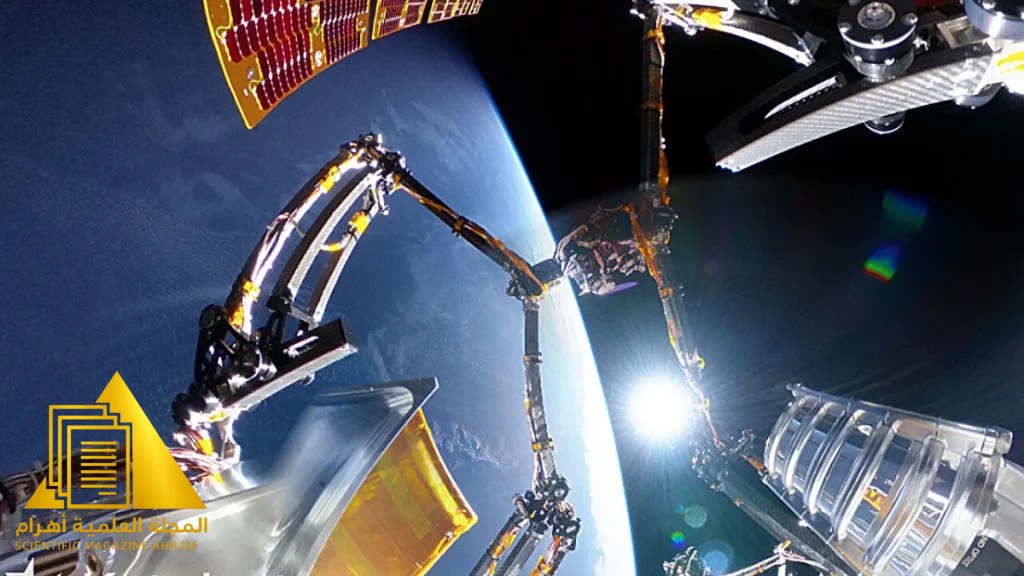

An Ambitious Mission Ending in the Atmosphere
Recent days have witnessed an unexpected end to a space mission that aimed to write a new chapter in the history of space exploration. An automated spacecraft developed by a private company returned to Earth’s atmosphere, where it burned up and broke apart, bringing down the curtain on an ambitious mission that lasted less than three months. Its primary objective was to carry out a complex technical rescue operation for an aging telescope belonging to the US space agency NASA.
Mission Details and Space Challenges
The mission aimed to reach NASA’s aging telescope to provide technical support or extend its operational lifespan in Earth orbit. Despite the spacecraft’s innovative design, the mission faced substantial technical challenges that prevented it from achieving its intended goals. As field complexities in space mounted, engineering teams made the decision to end the mission, returning the spacecraft to our planet where it disintegrated upon atmospheric entry—a familiar fate for vehicles not designed for safe landing on Earth’s surface.
Are the Days of Aging Telescopes Over?
This event opens the door to a broader discussion about the future of servicing telescopes and satellites in our orbits. With space becoming cluttered with debris and devices that have exceeded their operational lifespans, orbital servicing technologies are becoming an absolute necessity rather than a luxury. Despite the failure of this attempt, it represents an important learning step. In space science, failures are not the end of the road, but rather fuel for upcoming innovations that will make space repair and rescue operations more precise and successful in the near future.
The Future of Private Space Industries
Private sector participation in space servicing missions points to a radical shift in the space economy. Although the results were not as hoped this time, the experience proved the ability of companies to build and launch complex spacecraft. The next challenge lies in developing more flexible technologies capable of handling the surprises that deep space imposes, ensuring the preservation of our scientific assets deployed in orbit and reducing the chances of them turning into space junk.
By: Hany Sallam
Source: phys.org


Latest video
تابع معنا تحليل قراءة الصحف اليومية مع الكاتب الصحفي Hany Sallam عبر