
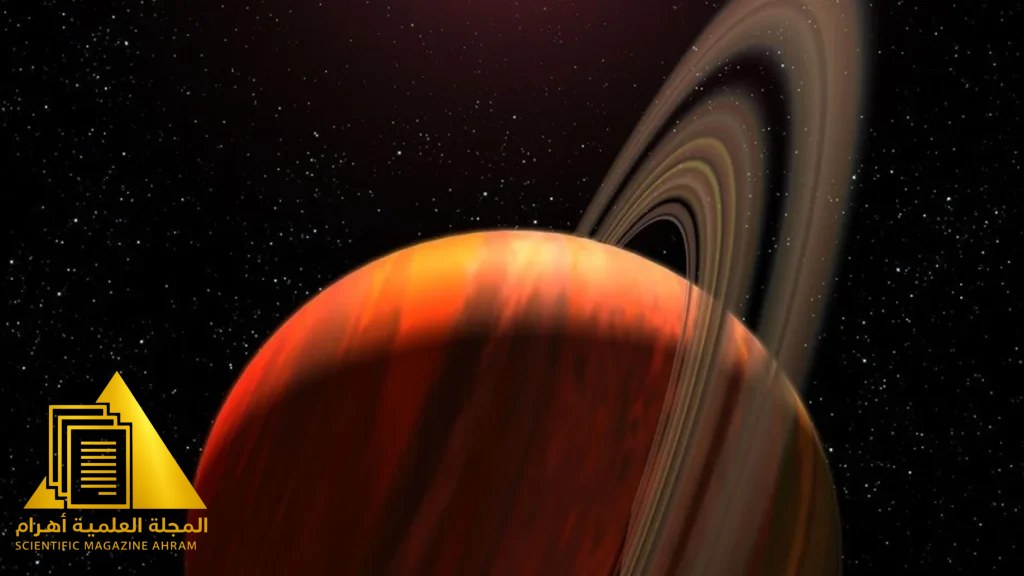

A New Window on Distant Worlds
In a continuous quest to uncover the secrets of the universe, the James Webb Space Telescope (JWST) has cast its remarkable light on HATS-6 b, a gas giant located 500 light-years from Earth. This vast distance was no obstacle to the telescope’s advanced capabilities, which succeeded in revealing fine details about the atmosphere of this distant world, opening the door to new scientific questions about the nature of planets outside our solar system.
Complex Chemical Composition
Precise observations led by a team of astronomers at the University of Maryland revealed a striking chemical mix in the planet’s atmosphere, detecting clear signatures of water vapor, methane, and ammonia. This discovery is not merely a list of gases, but a key to understanding how massive planets form and evolve in different stellar systems. The presence of ammonia in particular marks a milestone, helping scientists draw a more precise picture of the chemical reactions taking place under conditions of pressure and temperature that differ radically from what we know.
The Mystery of the Missing Heat
The biggest surprise facing scientists was not just in the atmospheric components, but in the planet’s temperatures. Data indicated that HATS-6 b is much colder than traditional computer models predicted. This unexpected coolness indicates that the planet’s relationship with its host star is not a simple orbital relationship, but is subject to complex physical interactions that remain mysterious until now.
Revisiting Planetary Models
These findings present astronomers with the need to reevaluate prevailing theories on how energy is exchanged between planets and their stars. If such a giant planet can maintain low temperatures despite its proximity to its star, this means that invisible mechanisms—perhaps related to the quality of clouds or the way radiation is absorbed and reflected—control the planet’s climate. Today, HATS-6 b is no longer just a distant point in space, but has become a natural laboratory testing our ability to understand the cosmic physics governing the worlds of our galaxy.
By Hany Sallam
Source: phys.org


Latest video
تابع معنا تحليل قراءة الصحف اليومية مع الكاتب الصحفي Hany Sallam عبر