
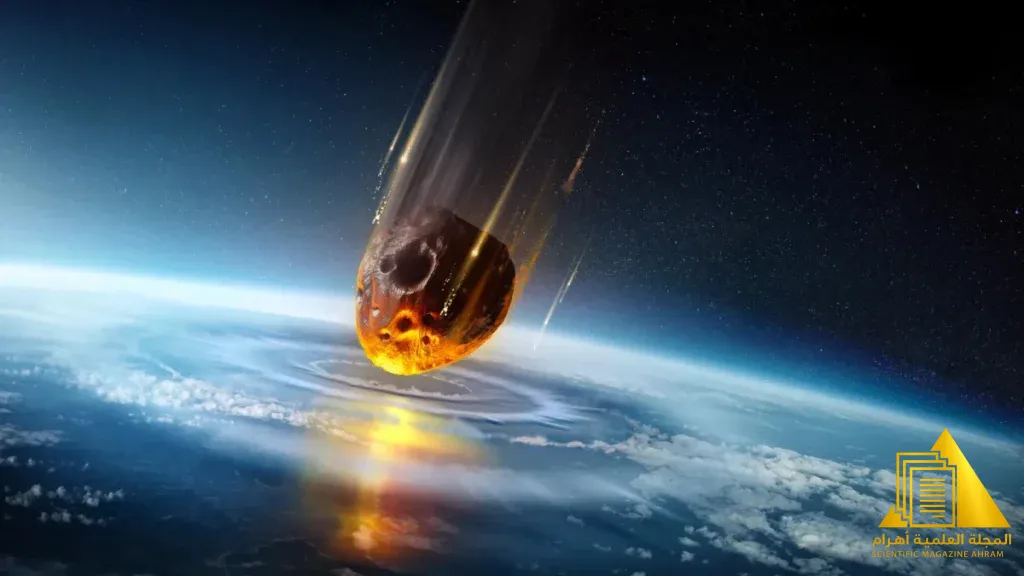

The Killer Asteroid Mystery: The Story of Creatures That Vanished 66 Million Years Ago
The most prominent question in our planet’s history has long been: What truly led to the demise of the dinosaurs 66 million years ago? For many years, scientists believed that sulfur
produced by a massive asteroid striking Earth was the primary suspect in blocking sunlight and freezing the planet. However, a recent scientific study has turned these concepts upside down, revealing that the secret to the extinction lies in the specific type of this rare space visitor.
Where Did the Mysterious Attacker Come From?
Precise chemical analyses of sediment layers following the impact indicate that the asteroid was not an ordinary space rock from the nearby asteroid belt, but rather belonged to a very rare type known as a “carbonaceous chondrite
” (CO chondrite). These bodies are not found in our cosmic neighborhood; instead, they originate in the remote, frozen regions of the solar system, far beyond Jupiter’s orbit.
Deadly Dust: The True Destructive Force
Contrary to the prevailing belief that sulfur gases caused the climate catastrophe, researchers explained that the unique chemical nature of this asteroid indicates that “rock dust” is largely responsible for the severe climate change. When the asteroid struck Earth, it caused massive amounts of fine dust to surge into the upper atmosphere, blocking sunlight for a long period and triggering a sudden, violent cooling of the Earth that massive creatures like dinosaurs were unable to adapt to.
Why Do These Findings Change Our Understanding of History?
This discovery not only solves the mystery of the dinosaur extinction, but it also alters our view of how Earth interacts with celestial bodies coming from the far reaches of the solar system. Understanding the nature of this asteroid helps scientists build accurate models of past natural disasters, and it is an important step in space science to understand the formation of the solar system in its early stages, as well as the impacts that bodies coming from vast distances may leave on our planet.
By: Hany Sallam
Source: ScienceDaily


Latest video
تابع معنا تحليل قراءة الصحف اليومية مع الكاتب الصحفي Hany Sallam عبر