
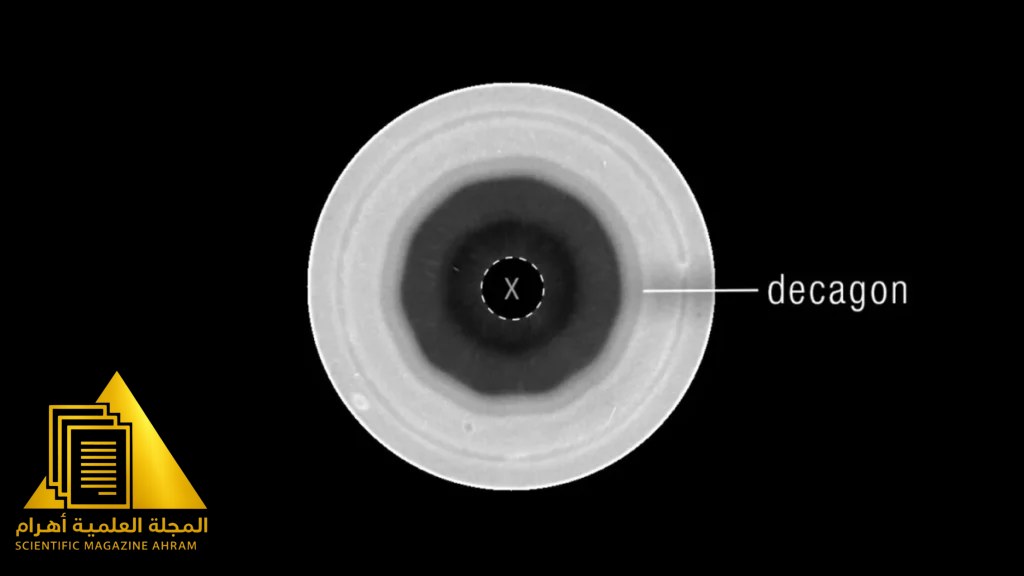

A New Cosmic Mystery in the Depths of Saturn
Saturn, the jewel of the solar system, has long captured scientists’ attention with its fascinating moons and breathtaking rings. Today, however, the spotlight turns back to this gas giant after the latest images of its south pole captured a mysterious geometric phenomenon: a decagonal polygon decorating the atmosphere above that frozen polar region, in an unexpected discovery that raises intriguing questions about the atmospheric physics of giant planets.
From Hexagon to Decagon: Coincidence or Pattern?
For decades, astronomers have observed the famous hexagon at Saturn’s north pole—a massive storm with six surprisingly stable sides. Now, the south pole appears to be mimicking this geometric creation, but in a more complex way. The new decagon appeared unexpectedly, suggesting that Saturn’s dynamic nature still holds surprises that go beyond our current models of how weather patterns form on giant planets.
Behind the Curtain: What Is the Secret of This Formation?
Researchers believe these geometric shapes are simply the expression of complex atmospheric waves moving through the planet’s atmosphere. On a planet composed of gases, differences in temperature and wind speeds can create regular wave patterns that appear to us as precise geometric shapes. Yet the mystery of the decagon remains puzzling: what hidden forces compel these winds to take this specific shape, and is it a temporary stability or a phenomenon that will last for years, much like the north pole hexagon?
A Window Into Planetary Physics
Observing such patterns is not merely about visual beauty; it serves as a natural laboratory that helps scientists understand fluid and gas dynamics under extreme conditions that cannot be simulated on Earth. With every new image sent by our space probes, the scientific community realizes that Saturn is not just a random mass of gas, but a tightly controlled cosmic system governed by precise physical laws that reveal themselves in stunning geometric forms. Scientists will continue to monitor this decagon to analyze its evolution, trying to decode the atmosphere of one of our solar system’s most mysterious planets.
By: Hany Sallam
Source: smithsonianmag.com


Latest video
تابع معنا تحليل قراءة الصحف اليومية مع الكاتب الصحفي Hany Sallam عبر