
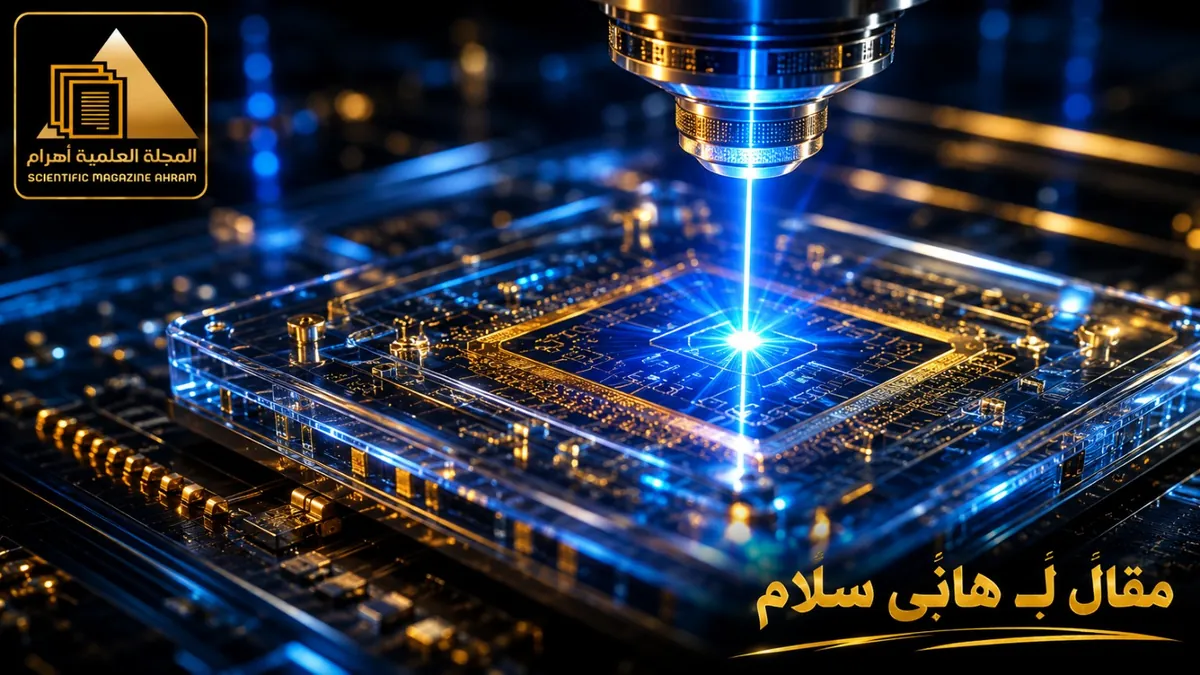

In the world of technology, there are ideas that look simple on paper yet turn into immense challenges when scientists try to put them into practice. Among these challenges is a dream that has haunted researchers for more than twenty years: placing an ultrafast laser inside a tiny chip that can be used in future devices.
Today, a research team has announced an important step in this direction after succeeding in integrating a femtosecond laser into a small, integrated chip. This achievement counts as one of the most exciting developments in the field of integrated photonics in recent years.
Although the news looks technical at first glance, its potential impact may extend to numerous fields, including communications, artificial intelligence, medicine, and advanced computing.
Why Is This Achievement Important?
Most current electronic devices rely on the movement of electrons to transport and process information. Yet light possesses an important advantage, which is its ability to carry huge amounts of data at astonishing speeds.
This is why scientists have spent years trying to harness light inside electronic chips instead of relying entirely on electrons.
However, shrinking advanced laser systems and integrating them into tiny chips posed a major obstacle to this dream.
Why Did It Take More Than 20 Years?
Ultrafast lasers need a high degree of precision and stability during operation. They also require specialized components that are very difficult to integrate into an extremely small space.
Because of this, researchers faced numerous technical challenges related to design, manufacturing, and controlling light within the chip itself.
Yet recent advances in nanomanufacturing techniques have helped scientists overcome a large part of these hurdles.
What Is a Femtosecond Laser?
This type of laser emits astonishingly short pulses. These pulses are measured in femtoseconds, which is an extremely tiny fraction of a second.
For comparison, a single femtosecond is shorter than a second by millions of billions of times.
These ultrafast pulses allow for extremely precise measurements and experiments across multiple fields.
How Might This Impact Our Lives?
This technology may help develop faster and more efficient communication systems in the future.
It can also contribute to improving the performance of data centers and the digital infrastructure that artificial intelligence applications depend on.
Furthermore, these miniaturized lasers may find important applications in medical devices and precise measurement tools.
Are We Facing a New Generation of Chips?
This achievement does not mean that current devices will change immediately. Even so, researchers view it as an essential step toward developing chips that rely on light to a greater degree than ever before.
If these technologies continue to advance, we may see the emergence of faster and more energy-efficient devices in the coming years.
The Beginning of a New Phase
Some researchers describe this achievement as a long-awaited step in the world of integrated photonics.
After more than two decades of attempts, what once seemed impossible has grown closer to reality. This development may be the beginning of a new phase in which electronic chips use light in ways that were not possible before.
Hany Sallam


Latest video
تابع معنا تحليل قراءة الصحف اليومية مع الكاتب الصحفي Hany Sallam عبر