

Report by / Waleed Bakr
Former Supervisor, Al-Montazah 1 Administration, Alexandria
Introduction/
I will examine the test impartially, viewing it through many eyes: first, as an exam-setting specialist; second, as a practicing teacher; and third, as a parent, since my daughter is a third-year secondary school student.
I will address some of the issues raised about certain questions, sharing only my professional opinion from a specialized standpoint.
First: Exam Data
The following table shows the percentage of questions for each chapter in the exam. The relative weight is very good, familiar as in every year, and appropriate to the weight of the units in the school textbook, with 42 marks allocated to the first unit (electricity) and 18 marks to modern physics.

The exam is of medium or slightly above medium difficulty, rated at 6 out of 10. The difficulty stems from the test as a whole rather than from the difficulty of the questions themselves. Difficulty and ease levels are calculated not just on the question alone, but also factoring in the time required to solve it.
Second: Exam Analysis
As a specialist, it took me less than an hour to solve the exam (50 minutes). I always multiply by a factor of 3 for the average student; consequently, the exam takes 150 minutes—which equals two and a half hours for the average student—providing enough time to solve it on the bubble sheet, but without sufficient time for review.
After surveying several students classified throughout the year by skill, efficiency, speed, and familiarity with solving various types of questions, I found the following:
- High-achieving students finished the entire exam in just two hours, reviewed in half an hour, and used the remaining time to fill in the bubble sheet.
- Above-average students (who were slow at solving throughout the year) finished the exam in two and a half hours, transferred their answers to the bubble sheet, and managed a quick review of only part of the remaining time.
- Average students took two hours and 50 minutes, leaving the remaining time for a quick transfer to the bubble sheet without any review.
- Lower-achieving students could not finish the entire exam and guessed some questions randomly on the bubble sheet.
It is clear from this that the perceived difficulty of the exam rises above average due to time constraints, as not all our children are top students. This point should have been considered when setting the exam, as it requires considerable time just to transfer answers to the bubble sheet. I believe this time factor is what caused dismay among most students and parents.
My definition of the average student is someone who studies all their lessons as they go, while acknowledging individual differences between them and higher-achieving students, which is completely natural since God created us different. In addition, they were taught by a professional teacher who knows every small and large detail of the curriculum, possesses the ability to simplify it, and focuses on key areas. Thus, there are three pillars in this process: the student, the actual curriculum studied during the year, and any flaw in any pillar increases the difficulty of the situation and the perceived difficulty of the exam, yet this is not accounted for while setting the questions. In my personal opinion, this is the core of the problem.
I will not discuss every question and my classification because this report is somewhat brief, and I will review some of the issues raised about certain questions after the exam.
Second: Questions in Question
Question 1: Electron Flow in a Wire Exposed to a Magnetic Field
This question sparked much debate and argument over whether the effect results from the Lorentz force or the superposition of magnetic fields.
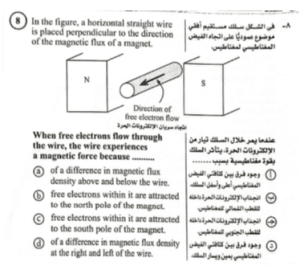
References state that the Lorentz force is determined by the equation:
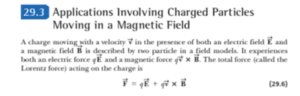
which ultimately leads to the formula used in the school textbook:
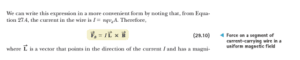
The following image is from the revised additional school textbook for 2023-2024, page 95, Chapter Two.
The decisive factor is that if something is not in the school textbook, we resort to references. The school textbook’s new, enhanced version released last year contains the image I will attach next, after which I will list the references and images as proof.
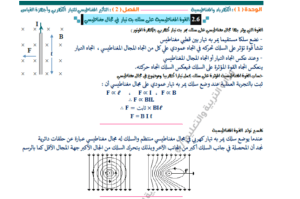
The law is indeed the Lorentz force, but the exam question did not ask about the formula; instead, it asked for an explanation of the phenomenon. If we use the Lorentz force and Fleming’s left-hand rule, the result is the same: the wire moves downward. If teachers examine the information closely, they will find the explanation in the very same book on the same page. However, I will bring proof from references because some colleagues do not rely on the school textbook, even though it is the sole reference when a problem arises.
First Evidence:
The book from the esteemed Cambridge University
Cambridge International AS and A Level Physics 2nd edition
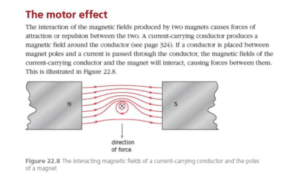
Here, the superposition of magnetic fields is clearly visible, which matches precisely what was mentioned in the question.
Second Evidence: Reference
Physics for Engineers and Scientists — 3rd ed. Vol. 2 [Hans C. Ohanian John T.
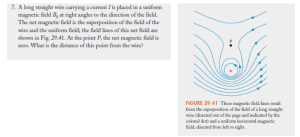
We also find here the superposition of fields, which will inevitably lead to upward movement. This image matches the question in principle. I conclude this with decisive evidence from the MIT 8.02 course book, taught by the famous physicist Walter Lewin.
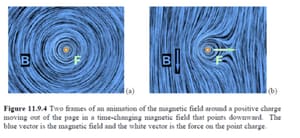
Here is the link to the video on the prestigious university’s website, which will not risk its reputation by presenting incorrect information.
https://web.mit.edu/8.02t/www/802TEAL3D/visualizations/magnetostatics/forcemovingq/forcemovingq.htm
Second Question: The Color of a Helium-Neon Laser Photon:
Since some colleagues argued that helium-neon emits red, green, infrared, and ultraviolet light, and therefore this question should be cancelled.
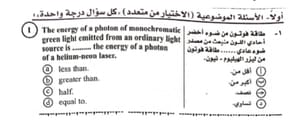
I will draw the answer exclusively from the school textbook, which is sufficient, along with some additional information that requires an experienced teacher who knows the curriculum thoroughly and understands its context.
I will present a set of images from the school textbook itself, which show that the light emitted by the helium-neon laser is red only in our curriculum.
First Image:
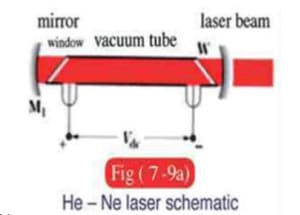
It shows red only inside and outside the device.
Second Image, which also shows only red-orange light.


These are the following wavelengths:
3390nm – 543.5nm -632.8nm – 152.3nm
These spectra are not lasers; rather, they are stimulated spectra that have not yet reached the laser stage, as there is a resonant cavity that performs amplification. A laser is the product of two coupled processes: stimulated emission followed by amplification. Speaking more specifically, a resonant cavity of certain dimensions causes destructive interference for all non-red spectra and amplifies only one spectrum, which is the red one. Therefore, only red emerges, not all of them. Thus, the question is 100% sound and presents no problems at all, as information must be presented completely rather than in truncated form. Of course, there are other devices for other frequencies, but they are outside the scope of our curriculum.
Third Question: AC Motor:
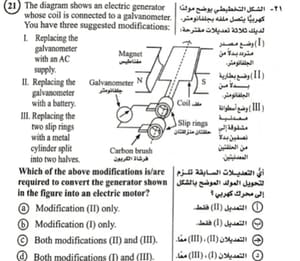
Since some colleagues called for including modification I among the answers because it is a possibility, the response is as follows:
First, the student has not studied this type of motor, and it does not appear anywhere in the curriculum, whereas they studied modifications II and III.
Therefore, answer b is completely discounted. Since option I did not appear in any other answer, the only correct choice is number C.
It might be considered if numbers II and III were absent, but when water is present, dry ablution is void. Furthermore, the alternating current motor requires many controls and has numerous problems, such as:
1- Self-Induction
- Due to the continuous change in current, a back EMF (electromotive force) is generated in the coil that impedes the flow of current.
- This phenomenon reduces engine efficiency, especially at startup.
2- Vibration and Noise
- Changes in current value cause changes in magnetic force, which may cause unwanted mechanical vibrations and noise in the motor.
3- Low Starting Torque
- In some motors, alternating current does not generate enough torque to start movement immediately.
4- Cyclic Heating
- With every electrical cycle, the current intensity changes, resulting in very rapid heating and cooling cycles.
- This causes thermal stress on the copper windings and insulation.
5- Low Frequencies:
- Low frequencies may cause vibration in the coils and an inability to start rotation, as well as the burning out of the coils due to overheating.
5 – Frequency Consistency:
- The frequency must match the rotation speed and rotation angle, as any discrepancy between them causes the motor to stop spinning.
All of these are constraints and obstacles for an alternating current motor. Naturally, whoever provides information must state its constraints.
Question Four: The Last Essay Question
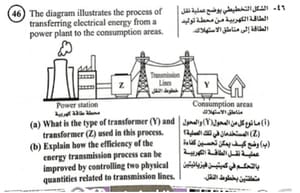
This is an open-ended question that allows for many answers, and I believe this was taken into account during grading since the question has multiple answers.
Any two choices are considered correct because the physical quantities were not specified in the question, and the answers are:
1- increasing voltage
2- decreasing current
3- using copper wires of less R
4- wire of least resistivity
5- A thicker wires
6- less length (spider Web instead of long parallel web)
7- Use of (HVDC) DC HIGH VOLTAGE
8- decreases voltage drop of wires
9- good isolators from air
10- good connector between wires
11- good maintenance
All of these are correct answers.
Naturally, since it asks to control physical quantities, solutions 1 through 9 are correct.
Question Statistics
First: Model Questions
Number of Questions: Those that appeared in the model papers or follow the same pattern: 23 questions (18 questions worth one mark and 5 questions worth two marks), totaling 28 marks, which is equivalent to 46.67% of the exam.
Question Numbers: (2, 4, 6, 7, 8, 9, 10, 11, 13, 14, 15, 16, 22, 23, 28, 29, 30, 31, 35, 37, 38, 40, 44)
Second: Previous Exams
Questions that appeared in previous exams, similar questions, or those following the same pattern
Number of Questions: 14 questions (8 questions worth one mark and 6 questions worth two marks), totaling 20 marks, which is equivalent to 33.3% of the exam.
Question Numbers: (3, 5, 12, 17, 18, 19, 21, 25, 33, 34, 36, 41, 42, 43)
Third: School Textbook
Questions that appeared in the revised school textbook for the 2023-2024 edition, similar questions, or those following the same pattern
Number of Questions: One question, which is question number (45)
Consequently, more than 80% of the exam content has been seen before.
Fourth: New Questions
Number of Questions: 8 questions (6 questions worth one mark and 2 questions worth two marks)



Latest video
تابع معنا تحليل قراءة الصحف اليومية مع الكاتب الصحفي Hany Sallam عبر