
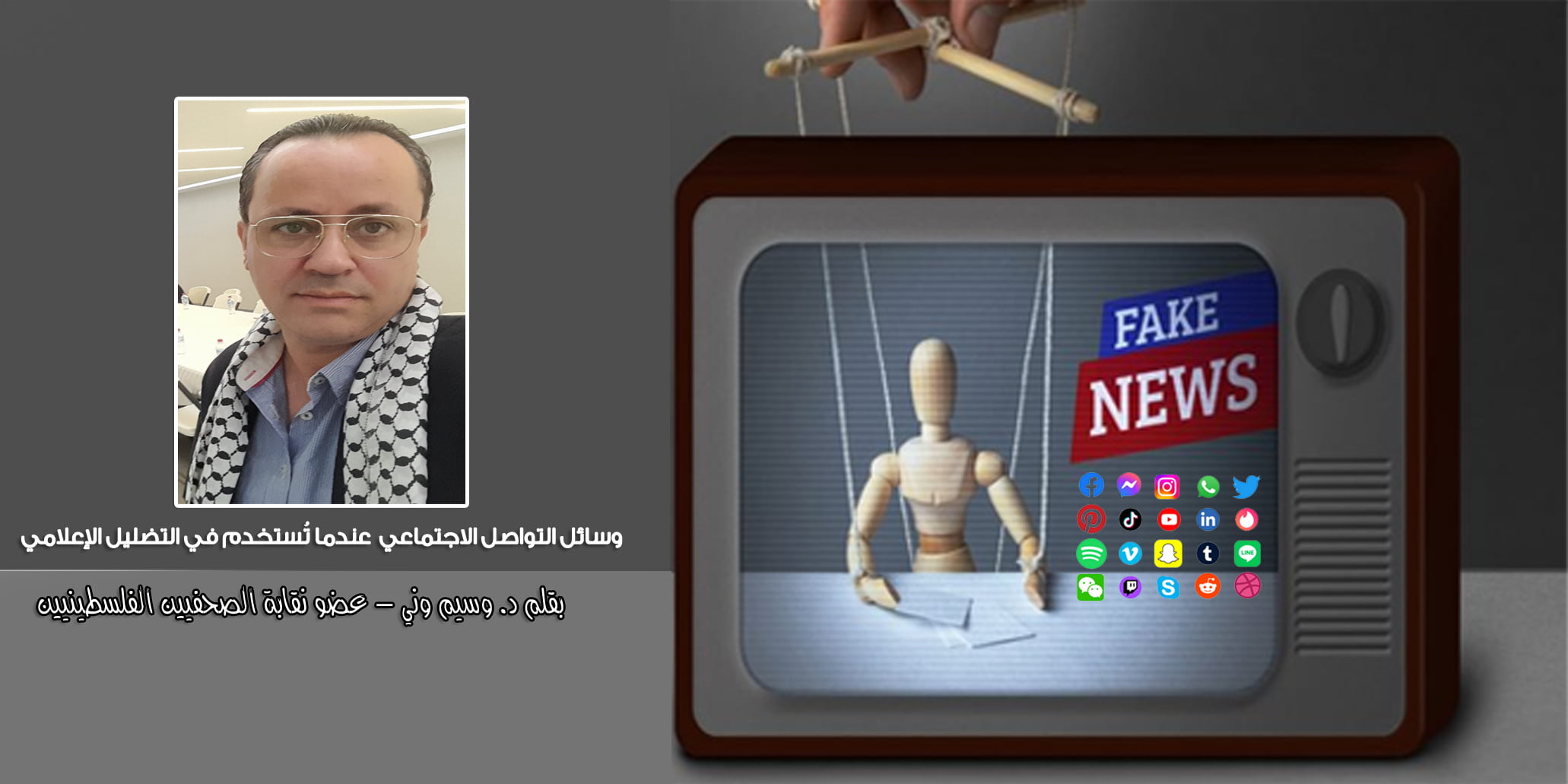

By Dr. Wassim Wane – Member of the Palestinian Journalists Syndicate
"While accurate information is the oxygen of our modern era, misinformation is carbon monoxide that can alter our perceptions and poison the minds of generations."
Since the dawn of humanity, people have needed to communicate with one another, marking the beginning of communication processes from face-to-face interpersonal communication to collective communication relying on mass media such as newspapers, radio, television, and the internet (social media). We all need to communicate to stay informed about what is happening around us, which drove the spread of media aimed at transmitting news to and from all parts of the world through its various channels.
In recent years, technological developments have posed a major challenge to political and media work within the new media environment. Social media platforms (Facebook, Twitter, Instagram, WhatsApp, and others) have multiplied and flourished, and their wide reach and growing audience have given them a powerful influence in attracting followers, making them a central axis in propaganda and vote-attracting efforts in any conflict or war in the region.
Of course, media outlets are widespread in our society—particularly WhatsApp and Telegram news groups. Scarcely any home is without an internet connection and smartphones, and each of us tries to follow the news in our own way by choosing specific leanings or convictions. But the most important question remains: do these news outlets, from which we draw our information, convey it to us objectively and with complete transparency? Is it transmitted from reality without processing, distortion, falsification of certain facts, or concealment of certain events? We have come to live in a school of media distortion, and most importantly, how do we educate people—especially youth, who are the demographic most engaged in various and conflicting media arenas—about methods of media distortion?
Therefore, presenting part of the truth and wrapping it in directed facts has become one of the tricks used to distort awareness and manipulate minds, or to build on facts by reframing them in a way that serves the sender's goal and achieves the purpose of the distortion. Ultimately, the means are numerous, but the distortion is one.
Here, the classic task of a journalist is no longer merely to convey events and news, but to search for the truth and verify it—a heavy burden for many who have grown accustomed to easy publishing and naive or cunning engagement with the fabricated at the expense of verified facts. Media distortion industries may easily succeed, if there is laxity in resisting them and spreading awareness on how to confront them, in making the following laughable statement all too sadly real. The success of distortion will mean: convincing people that a mute man told a deaf man that a blind man saw a paralyzed man chasing a lame man. And what was hidden is greater.
How can a follower avoid the distortion of certain media outlets, whether this distortion is deliberate deceit or unintentional professional error? Here are some skills that can help you do that:
Maintain skepticism: The aim here is for a person to scrutinize what they read or hear. This does not mean falling into obsessive suspicion and slander phobia, but having what Al-Mughirah ibn Shu'bah described in Umar ibn al-Khattab: "He has a mind that prevents him from being deceived."
Check the news source: Therefore, a reader may sometimes need to check the original source of the news.
Be alert to agendas: Be cautious of hidden directions and agendas.
Compare the news with another media outlet: It is preferable to turn to a neutral third party, and perhaps a fourth, fifth, and sixth depending on the importance of the subject, whose private agenda does not influence the news you are researching.
Do not be swayed by catchy headlines: When a headline conveys a statement to you or tells you a result, make sure to read the details of the news and verify the result. Do not be fooled by the idea that a book is known by its cover, as hot headlines are frequently used to mask cold content.
Verify the essential elements of the news: Every journalistic genre has necessary elements that a follower can notice with a bit of scrutiny, even without being a specialist. A news report, for instance, needs to answer the six familiar questions: What happened? How? Who did it? Where did it happen? When? And why, or what was the context in which it occurred?
Separate judgments and descriptions: Regardless of how appealing or disturbing the style of the news report is, ensure you are not influenced by the exaggerations, judgments, generalizations, and leaps it may contain, as these are frequently open to question.
Choose specialized media channels: Accessing news may be easy, but a specialist remains better equipped to evaluate, process, and demonstrate its importance. Similarly, specialized media outlets are expected to be more accurate, comprehensive, and better at presenting and analyzing the issues and topics they specialize in.
Build a truthful media platform: Therefore, you should build for yourself a network of media platforms that you have tried and tested—not based on reputation alone—in various fields. These will be your source of news, and you should return to them to verify what reaches you from outside them, while keeping in mind the aforementioned points for verifying professionalism and objectivity.
Ultimately, media disinformation is not born of supreme values and noble ethics, nor will it ever be a means to elevate or advance humanity. Instead, it is a compliant tool in the hands of backroom operators and those with suspicious agendas. Disinformation has played a subtle role in reshaping concepts and distorting facts. Here, we need to recognize the responsibility that rests on every official, as all of us must seek the truth. When we listen to what is true and real, grasp the dimensions of a story, and realize that those who target societies want people to follow them simply for exploitation, only then can we distinguish truth from falsehood and protect our concepts, morals, and values from the dangers of the hidden conflict on social media—especially when it is used for media disinformation.


Latest video
تابع معنا تحليل قراءة الصحف اليومية مع الكاتب الصحفي Hany Sallam عبر