

Journey to the Dawn of Time
In a scientific achievement that rivals science fiction, researchers at the European Organization for Nuclear Research (CERN) have managed to turn back the clock—specifically to the very first moments following the Big Bang. Scientists succeeded in creating a miniature, microscopic version of the infant universe through ultra-precise collision experiments, thereby opening a new window into understanding the secrets of the matter that formed the foundational building blocks of existence.
Quark-Gluon Plasma: The Primordial Soup of Matter
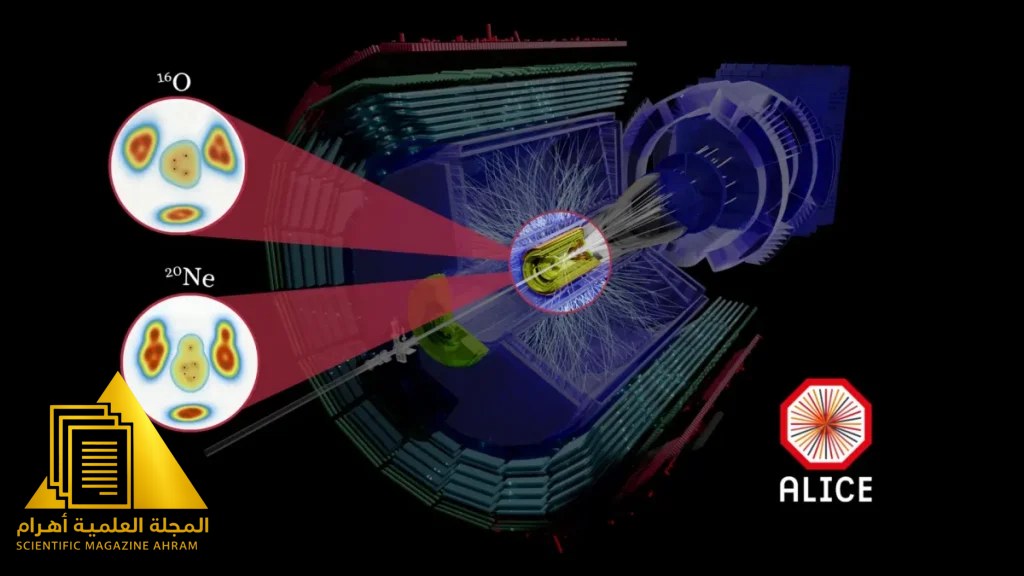
In their experiment, scientists accelerated tiny atomic nuclei to near-light speed and forced them to collide with one another. These violent collisions did not merely shatter the atoms; they created a rare state of matter known as quark-gluon plasma. In this state, protons and neutrons break apart, liberating the quarks and gluons that bind them, which recreates the hot, dense “cosmic soup” that filled the universe in fractions of a second after its birth.
Smaller Than Expected… Yet Stronger
The research team’s stunning surprise was that the atomic nuclei used in the experiment were smaller in size than previously assumed necessary to produce such an interaction. This discovery not only changes our understanding of atomic nucleus physics, but also provides scientists with an entirely new tool; the experiment proved that the particles resulting from the collision carry a “signature” or geometric shape that reflects the form of the nucleus from which they originated. This development means that we no longer need massive, impossible experiments to see nuclear structure, as we can infer it by analyzing the collision remnants.
Why Does This Discovery Matter?
The importance of this study is not limited to nuclear laboratories, but extends to answering major existential questions. By observing how this primordial matter forms and dissipates in fractions of a second, we learn about the physical laws that governed our universe’s evolution from its inception. Every atomic collision serves as a time-lapse camera capturing images of what the world was like billions of years ago, bringing us closer than ever to understanding how matter gathered to form the stars and galaxies we see today.
By: Hany Sallam
Source: ScienceDaily


Latest video
تابع معنا تحليل قراءة الصحف اليومية مع الكاتب الصحفي Hany Sallam عبر