
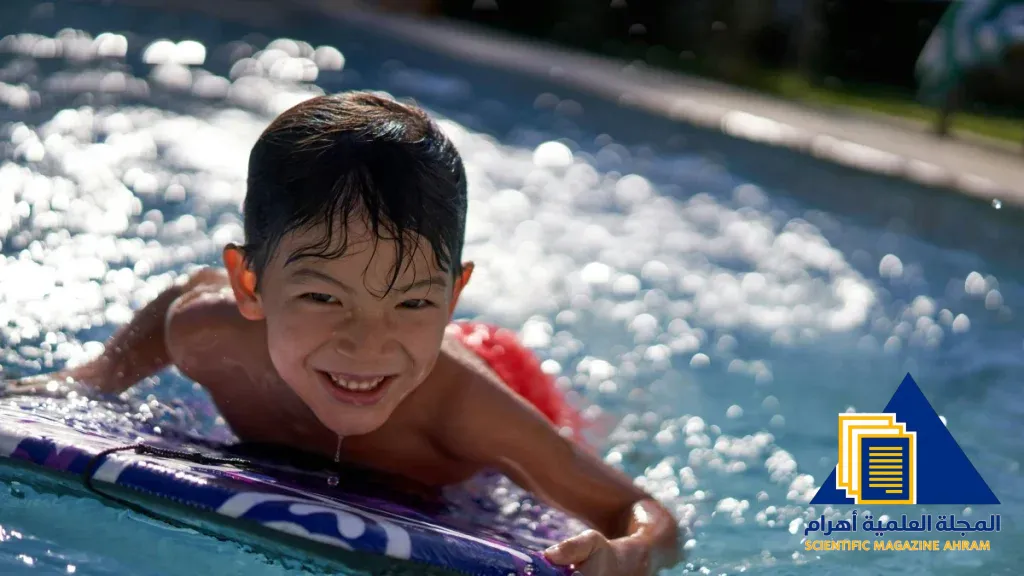

Your Golden Gateway to Your Child’s Intelligence
Amid the growing financial pressures families face, children’s recreational and sports activities are often the first casualties when budgets are cut. At the forefront of these activities are swimming lessons, which some mistakenly view as mere luxuries or passing summer skills. However, recent scientific research turns this equation on its head, confirming that swimming is not just physical exercise for building muscle, but a magical tool for developing children’s mental, social, and academic skills.
The Impact of Water on Activating Brain Cells
When a child enters the water, not only does their body move, but their brain works at full capacity. Swimming requires complex coordination between limbs and breathing movements, which forces the left and right hemispheres of the brain to work together in complete harmony. Studies indicate that these reciprocal water movements promote the formation of new neural pathways, which directly reflects on a child’s comprehension abilities. Thus, we find that children who practice swimming show notable superiority in skills related to mathematics, problem-solving, and concentration inside classrooms.
Building Confidence and Friendships at the Poolside
Alongside the mental and academic benefits, the swimming pool plays a key role in children’s socialization. Being in a group environment where they learn a new skill requires ongoing communication and interaction with coaches and peers. This interaction breaks down shyness and builds a child’s self-confidence when they overcome their fear of deep water. Furthermore, teamwork and water games foster a spirit of team and cooperation, helping to shape social personalities capable of integrating easily into society.
A Call for Government and Community Support
Building on these findings, researchers are sounding the alarm, demanding a reassessment of how swimming is treated as a secondary activity. As families’ financial ability to cover training costs declines, the need becomes urgent for government and institutional intervention to support swimming education programs in schools and youth centers. Investing in teaching children to swim is not a luxury; it is a long-term investment in building a smarter, healthier generation better equipped to face future challenges with confidence and competence.
By: Hany Sallam
Source: phys.org


Latest video
تابع معنا تحليل قراءة الصحف اليومية مع الكاتب الصحفي Hany Sallam عبر