
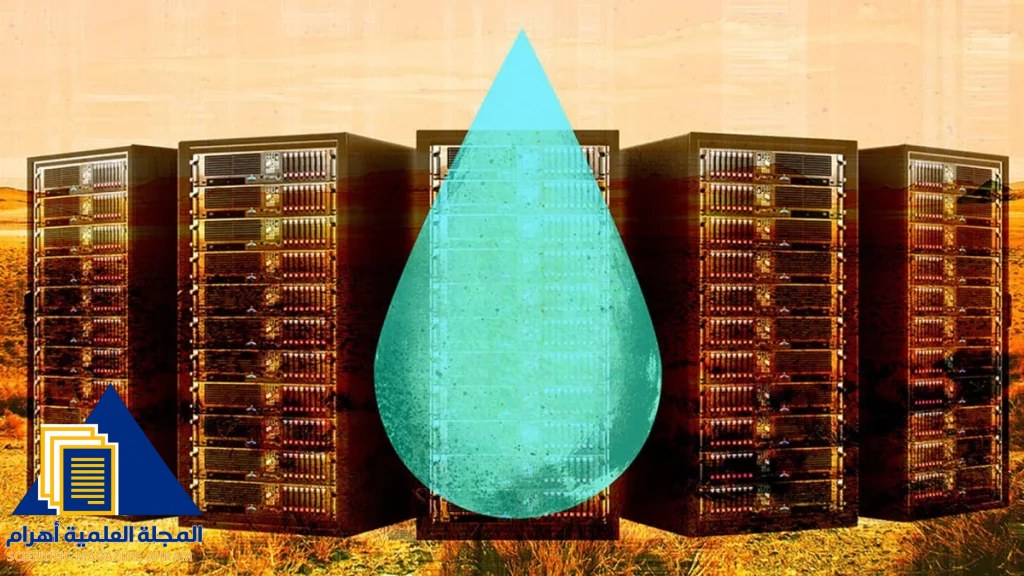

Tech Thirst: How Is Artificial Intelligence Consuming the Planet’s Water?
In the age of artificial intelligence, data centers have become the beating heart of modern civilization, responsible for processing the billions of calculations that power our daily lives. Yet behind phone screens and promises of advanced technology lies an invisible environmental challenge: the massive thermal noise generated by servers, which requires huge amounts of water for cooling, raising serious questions about the sector’s sustainability.
Water Cooling: The Hidden Tax
Data centers rely on cooling systems that depend primarily on water evaporation to keep processors stable and reduce heat. While the water consumption of these facilities may not seem huge compared to agriculture or heavy industry, the problem lies in location, as these centers are often built in areas already suffering from water stress. This competition for freshwater resources places growing pressure on local communities and the surrounding environment.
Renewable Energy as a Lifeline
Experts point out that the solution does not lie in stopping innovation, but in reshaping operating mechanisms. Transitioning from reliance on traditional energy sources to solar and wind power not only cuts carbon emissions, but can also help reduce reliance on traditional, water-intensive cooling cycles. In addition, innovative cooling technologies, such as advanced liquids or closed-loop cooling systems, provide promising opportunities to significantly reduce the water footprints of data centers.
A Smarter, Less Thirsty Future
Achieving sustainable artificial intelligence requires a delicate balance. It is not enough for algorithms to be brilliant; their underlying systems must also be responsible toward our planet’s resources. With growing global environmental awareness, water efficiency will become a crucial standard for evaluating tech companies. The future of digital transformation will be measured not only by processing speed, but by humanity’s ability to innovate without draining Earth’s only lifeline.
By: Hany Sallam
Source: livescience.com


Latest video
تابع معنا تحليل قراءة الصحف اليومية مع الكاتب الصحفي Hany Sallam عبر