

A Journey Through Time to the Dawn of Planet Formation
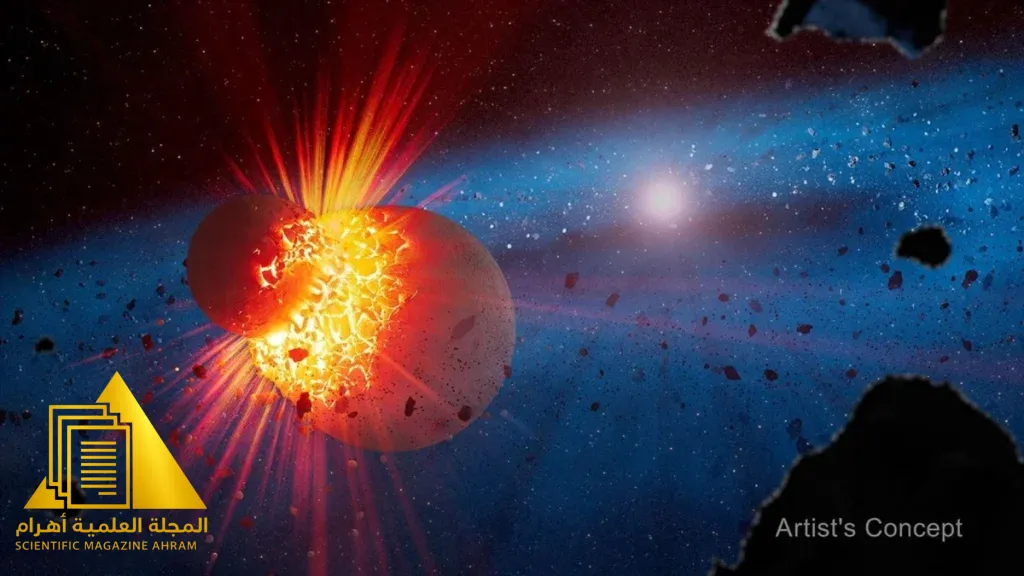
Deep in the cosmos, scientists are trying to answer a question that has long troubled humanity: How was the Moon born? While Earth was in its infancy billions of years ago, a catastrophic event is believed to have changed our planet’s face forever. A Mars-sized celestial body named Theia collided with the newborn Earth, sending massive rocky debris flying that later gathered to form the Moon we see today. Today, thanks to the James Webb Space Telescope, we no longer rely solely on theories; we now have a visual window observing the distant past.
Webb’s Window Onto Dusty Disks
Astronomers are using the James Webb Space Telescope to observe debris disks surrounding young stars in our galaxy. These disks are not just cosmic dust; they are natural laboratories mimicking the conditions our solar system experienced in its early stages. By studying these stellar systems, researchers can observe the violent planetary collisions taking place in the orbits of youthful stars, providing precise data on how planets form, collide, and evolve.
Secrets of Major Collisions
In their current studies, scientists are focusing on analyzing the composition of these rocky disks produced by the collisions of massive bodies. The infrared data captured by James Webb allows us to see beyond thick dust clouds and examine the nature of the debris resulting from those collisions. This information is key to understanding how frequently collisions similar to the one between Theia and Earth occur, helping us learn whether the formation of the Earth-Moon system is a unique event or a recurring phenomenon across the universe.
Toward a Deeper Understanding of Our Place in the Universe
These observations are not just documentation of space phenomena; they are a rewriting of the story of our world’s creation. Every collision observed in those distant stellar systems enhances our understanding of how planetary orbits stabilize and rocky moons form. Today, we stand on the threshold of a new phase of astronomy, where James Webb gives us the ability to read the geological history of the solar system by observing the future of other systems, ultimately discovering that our story with the Moon is part of a grand cosmic symphony that began billions of years ago and continues to this day.
By: Hany Sallam
Source: universetoday.com


Latest video
تابع معنا تحليل قراءة الصحف اليومية مع الكاتب الصحفي Hany Sallam عبر