

Debunking AI: A Theoretical and Practical Guide to Deconstructing Deepfakes
“The War of Pixels and Biology: How to Spot AI Algorithmic Deception with the Naked Eye”
By Dr. Ola Mahmoud Moawad
Lecturer in Business Information Systems
Digital Transformation and Artificial Intelligence Consultant

Deepfakes are no longer just a fleeting visual trick for amusement or entertainment. They have rapidly transformed into a strategic digital weapon capable of defeating public awareness, distorting scientific and political facts, and ruining personal and institutional reputations with the click of a button.
In this article, we provide you with a comprehensive guide that combines the philosophical and theoretical deconstruction of how this complex technology works with practical steps to detect it using the naked eye and modern digital tools.
How Do Deepfake Videos Work?
To understand how to detect this sophisticated manipulation, one must first understand the philosophical and technical roots upon which artificial intelligence relies to manufacture a fake reality.
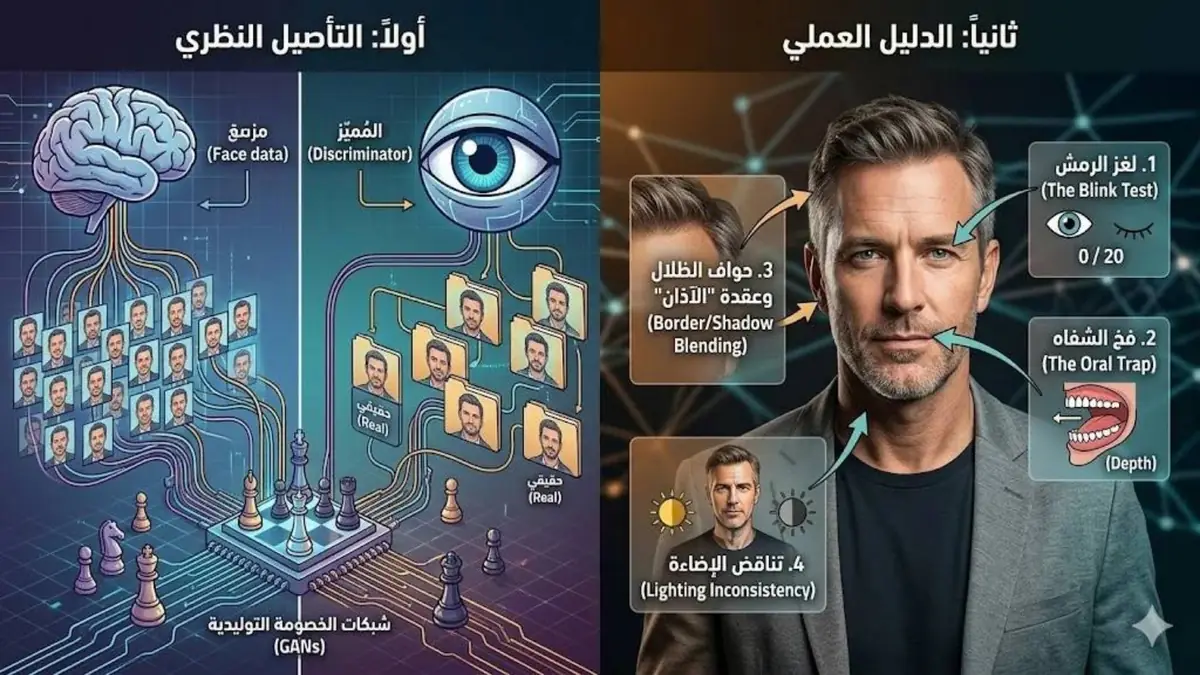
At their theoretical core, AI-generated fake videos rely on an advanced architecture of deep learning algorithms known as:
Generative Adversarial Networks
(Generative Adversarial Networks)
or GANs for short.
These networks represent a revolution in the computing world because they do not rely on teaching the machine through traditional commands. Instead, they allow it to learn independently by simulating competitive human thinking and developing its capabilities over time.
How GANs Work
Deepfake technology relies on a continuous digital competition between two intelligent models:
The First Model: The Generator
This model handles creating the fake video. It relies on being fed thousands of images and clips of the target subject to produce digital expressions that look natural.
The Second Model: The Discriminator
This model acts as a strict digital investigator that compares the resulting video with real content based on pixel distribution and fine visual details.
This computational match continues millions of times until the generator succeeds in minimizing its errors and producing a hyper-realistic video that is difficult to detect.
Why Can Deepfake Videos Be Detected?
Despite the technical brilliance of these algorithms, artificial intelligence remains a mathematical system that lacks a complete biological understanding of the laws of human movement and realistic physics.
Therefore, a set of organic errors emerges that reveals the manipulation easily upon closer inspection.
Common Flaws in Fake Videos
Blinking Disruptions and Eye Movement
Some algorithms fail to simulate the natural human blink rate, which generally ranges between 15 and 20 blinks per minute.
As a result, a person may appear:
with a blank stare for a long period
or blinking in an erratic and unnatural manner
This is considered one of the most prominent indicators of deepfakes.
Mouth and Lip Distortion
Some artificial intelligence systems fail to simulate:
the anatomical depth of the mouth
teeth movement
tongue movement
complete synchronization between audio and lips
Teeth also sometimes appear as an unrealistic plastic mass, especially when slowing down the video.
Shadow and Blending Issues
Certain visual distortions appear in:
the hairline
the neck
the ears
glasses and accessories
Blurriness or shaking may also occur during fast head movement due to the algorithm’s delay in repositioning the digital face.
Lighting and Physics Contradictions
Some fake videos fail to achieve a natural and balanced light reflection.
Therefore, you may notice:
illogical shadows
disturbed reflections
differences in the lighting direction within a single scene
These contradictions reveal digital manipulation in the video.
Digital Tools for Detecting Deepfakes
If the video bypasses the visual inspection stage, advanced technical tools can be used to analyze the content digitally.
Among the most prominent of these tools are:
The InVID plugin for frame analysis
Reverse video analysis tools
Pixel detection software
Audio frequency analysis tools
Digital content verification platforms
These tools help determine the probability of manipulation with a high degree of accuracy.
Conclusion
Deepfakes have become one of the most dangerous tools of digital disinformation in the age of artificial intelligence. Therefore, verifying videos is no longer a technical luxury, but a necessity to protect truth and public awareness.
As algorithms continue to evolve, the ability to detect deepfakes will become an essential skill in the modern digital world.


Latest video
تابع معنا تحليل قراءة الصحف اليومية مع الكاتب الصحفي Hany Sallam عبر