
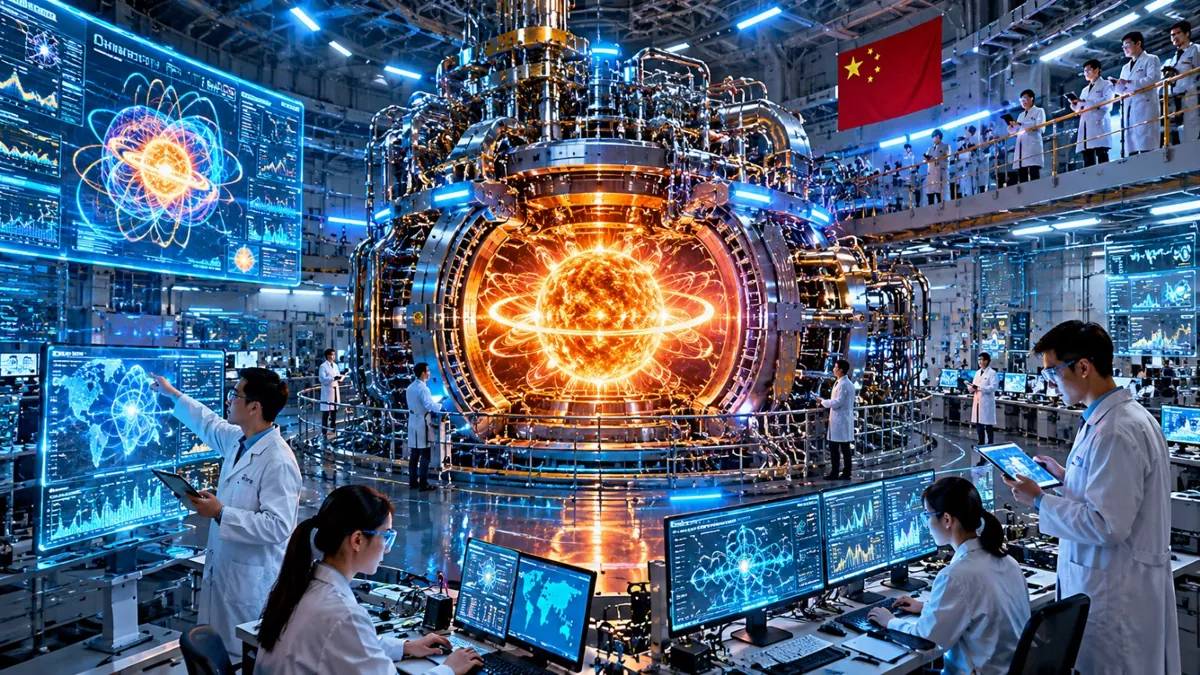

Scientists in China have moved closer to realizing one of the most ambitious scientific dreams of the modern era, after China’s EAST nuclear fusion reactor recorded a new breakthrough that may pave the way for producing what is known as an “artificial sun.”
Energy experts believe that this technology could transform the future of global electricity generation because it relies on a clean, virtually limitless energy source similar to the reactions that take place inside the real Sun.
What Is an Artificial Sun?
The “artificial sun” does not rely on traditional fuels such as oil or gas; instead, it uses nuclear fusion technology.
This technology attempts to fuse light atoms under extreme temperatures to release massive amounts of energy, which is the same process that gives the Sun and stars their natural power.
Scientists hope that this technology will eventually become a safe source of clean energy without massive carbon emissions or long-term nuclear waste.
A New Chinese Achievement
The Chinese news agency Xinhua reported that the EAST reactor has achieved an important breakthrough in stabilizing superheated plasma inside the reactor, which is one of the biggest challenges in nuclear fusion research.
Scientists also succeeded in maintaining the plasma for longer periods than before at temperatures several times higher than that of the Sun itself.
Researchers say that controlling plasma represents the hardest hurdle on the path to producing stable and commercially viable fusion energy.
Why Is the World Interested in This Project?
China’s “artificial sun” project is receiving significant global attention because nuclear fusion may provide in the future:
Virtually limitless energy
Low carbon emissions
Reduced reliance on fossil fuels
A stable source of electricity
Climate experts also believe that the success of this technology may help the world tackle the climate change crisis and accelerate the transition toward clean energy.
Global Scientific Competition
China is not working on this technology alone, as several countries and international institutions are racing to develop practical nuclear fusion reactors.
However, China has become one of the most advanced countries in this field in recent years, especially after massive investments in scientific infrastructure and advanced energy centers.
At the same time, Beijing is working on a new project named BEST, which aims to build a more advanced reactor that may eventually come close to actually producing electricity via nuclear fusion.
Are We Approaching the Energy of the Future?
Although scientists still face major technical challenges, recent developments have raised the level of optimism within the global scientific community.
Researchers believe that coming decades may witness a historic shift in how energy is produced if nuclear fusion technologies succeed in reaching the stage of wide commercial operation.
This is why some scientists describe the “artificial sun” project as one of the most important scientific projects of the twenty-first century.
Hany Sallam


Latest video
تابع معنا تحليل قراءة الصحف اليومية مع الكاتب الصحفي Hany Sallam عبر