
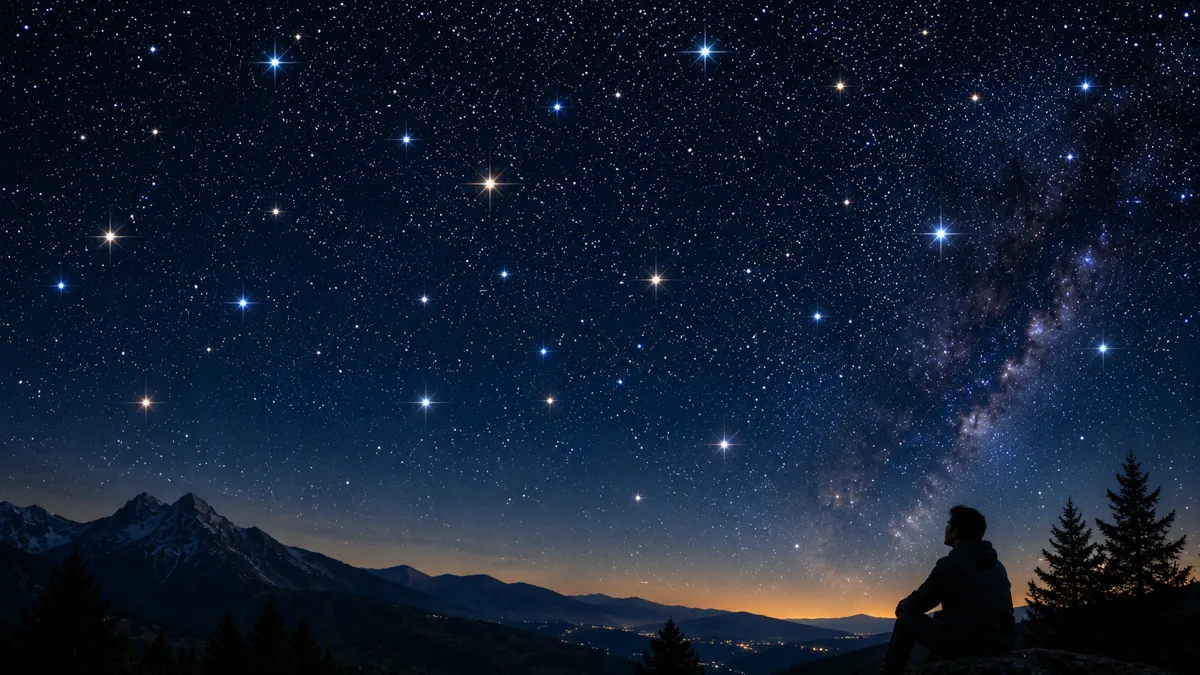

On clear nights, the stars look like tiny, pulsing living creatures. They do not shine with a steady, uniform light; instead, they twinkle and dim rapidly, as if the sky itself is breathing slowly above our heads.
This twinkling has puzzled humans since antiquity. Some ancient civilizations believed the stars were sending mysterious signals, while others imagined they were distant souls watching over the Earth from the heavens.
Modern science, however, has revealed that the secret does not lie within the stars themselves, but in the air that surrounds our planet.
The Long Journey of Starlight
Starlight reaches us from unimaginable, vast distances. Some stars are tens, hundreds, or even thousands of light-years away from Earth.
Throughout that long journey, the star’s light travels through space in a nearly straight line until it finally arrives at Earth’s atmosphere.
Here, the true story of starlight twinkling begins.
The Air That Bends Light
The atmosphere is not the calm, static layer it appears to be to us; rather, it is a massive ocean of constantly moving air. Air currents and varying temperatures cause the air to churn and change continuously.
When starlight passes through these turbulent layers, it is deflected slightly in multiple directions.
As a result, a star appears to move, twinkle, or rapidly change its brightness, even though it is actually shining steadily far away in space.
Why Don’t Planets Twinkle in the Same Way?
Some stargazers may have noticed that planets look calmer and steadier than stars.
The reason is that stars are very distant, so their light reaches us as extremely small points of light, making it easily disrupted by atmospheric turbulence.
Planets, by contrast, are relatively close and appear as small discs of light rather than precise points, which is why their light looks much more stable in the sky.
Colors Changing in an Instant
Sometimes the effect is not limited to twinkling alone; a star may also seem to change color rapidly between red, blue, and white.
This also happens because of atmospheric turbulence, which refracts the different colors of light to varying degrees as they pass toward us.
This is why some stars near the horizon look even more disturbed and changeable in color, because their light passes through a thicker layer of air.
A Sky That Looks Alive
Perhaps for this very reason, humans have loved the stars for thousands of years. The sky has never looked static, but rather full of subtle motion and shifting light.
When a person looks up at the stars twinkling in the silence of the night, they sometimes feel that the entire universe is moving slowly in a distant realm where no sound can be heard.
Even though science has uncovered the explanation for this phenomenon, the stars still retain their ancient magic, as if they refuse to be reduced to mere numbers and equations.
Hany Sallam


Latest video
تابع معنا تحليل قراءة الصحف اليومية مع الكاتب الصحفي Hany Sallam عبر