
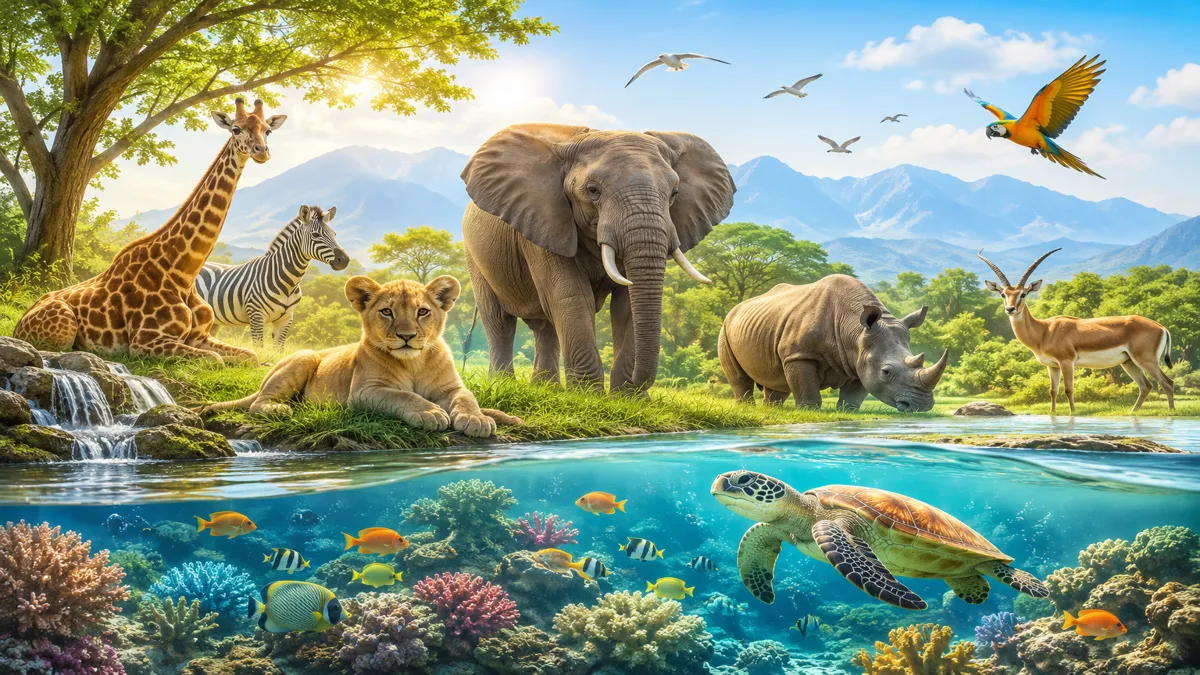

Wildlife in 2026: How Is Nature Resisting the New Extinction Wave?
Wildlife around the world is experiencing a delicate and unprecedented phase in 2026.
Scientists are tracking rapid changes in ecosystems, while thousands of species try to adapt to a changing climate and the loss of natural habitats.
Over recent months, important signs have emerged confirming that certain species continue to resist despite all threats.
Discovery of New Coral Reef Refuges
An international team of researchers has revealed roughly 166,000 square kilometers of coral reefs capable of withstanding climate change, a figure three times higher than previous estimates.
These areas may become “ecological refuges” that preserve marine biodiversity in the future.
This discovery gives scientists new hope for protecting the marine systems upon which thousands of creatures depend.
Emergence of New Deep-Sea Creatures
The Ocean Census expedition announced the discovery of more than 1,100 new marine species this year, including ghost sharks and rare worms living at depths exceeding 6,500 meters.
These discoveries confirm that the oceans still hold massive secrets that have yet to be uncovered.
Artificial Intelligence Enters the Battle to Protect Animals
Modern technologies relying on artificial intelligence have begun to be used to monitor wildlife, especially in remote areas.
The ICARUS project uses satellites to track animal migration and behavioral changes.
This development may help detect dangers before they occur, such as poaching or environmental disasters.
New Zealand’s Battle Against Rats to Save Birds
In one of the strangest environmental protection campaigns, New Zealand is continuing its massive project to eradicate invasive animals by 2050.
The reason is simple and dangerous: these animals are responsible for killing about 25 million birds annually within the country.
Recent efforts have helped rare bird species return to areas that were almost completely devoid of them.
Wildlife Between Hope and Danger
Despite the positive news, the danger remains.
Global warming, deforestation, and pollution continue to exert heavy pressure on wild creatures.
Yet 2026 has proven something important: nature does not surrender easily.
Every new discovery, and every rescued area, may hold the key to the survival of entire species for coming generations.
Quick Summary
The year 2026 reveals stunning developments in the world of wildlife, from the discovery of climate-resilient coral reef areas to the emergence of new marine species and the use of artificial intelligence in animal protection.
Read Also: Creatures Never Seen by Humans Before
Read Also: After More Than a Century, a Rare Giant Bird Returns to the Skies of an American State
Read Also: Hundreds of Rare Frogs Released in a Step to Save an Endangered Species


Latest video
تابع معنا تحليل قراءة الصحف اليومية مع الكاتب الصحفي Hany Sallam عبر