
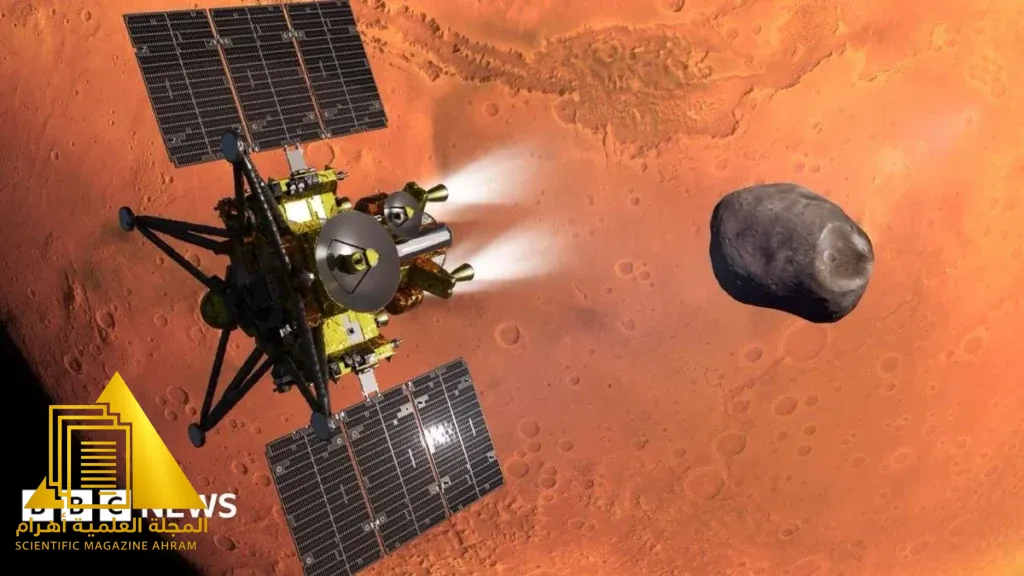

Journey into the Unknown: Mars and Its Moons in Human Hands
In a bold step that opens new horizons for astronomy, global space agencies are preparing to launch an unprecedented space mission aimed at reaching one of the moons of Mars. This journey is not only aimed at visual exploration, but carries a complex technical goal: landing on the surface of the moon, collecting samples of its rocky soil, and returning them safely to Earth for analysis in international laboratories.
Why Only 10 Grams?
A weight of 10 grams may seem like a tiny figure in the vast expanse of space, yet this quantity of space dust is considered a priceless scientific treasure. In Earth laboratories, these samples will undergo ultra-precise chemical and physical analysis techniques, allowing scientists to understand the mineral properties of the Martian moons with extreme precision. Studying these particles may settle a decades-long scientific debate over whether the moons of Mars are merely stray asteroids captured by the gravity of the Red Planet, or fragments resulting from a massive impact in Mars’ ancient history.
Landing and Return Challenges
The difficulty of the mission lies in the harsh environment the spacecraft will face. Landing on a small moon with weak gravity requires extreme technical precision to avoid bouncing off the surface. Furthermore, the process of launching from the moon and returning on a long space journey to Earth requires advanced propulsion technology capable of withstanding deep space conditions. This mission is not just an exploratory trip, but a test of humanity’s ability to return with samples from distant celestial bodies, which paves the way for more ambitious future missions that may include returning with samples from the surface of Mars itself or even other asteroids in our solar system.
Horizons of Science and Knowledge
Returning with “Mars dust” will reshape our understanding of the origin of Mars and its geological history. The moons act as a silent witness to the cosmic events surrounding the Red Planet, and by analyzing these samples, we hope to uncover information about the evolution of the solar system in its early stages. With every gram brought to Earth, humanity steps an additional closer toward answering the eternal question: Are we alone in this universe? And how did the planetary environments we see today form?
By: Hany Sallam
Source: BBC Science


Latest video
تابع معنا تحليل قراءة الصحف اليومية مع الكاتب الصحفي Hany Sallam عبر