
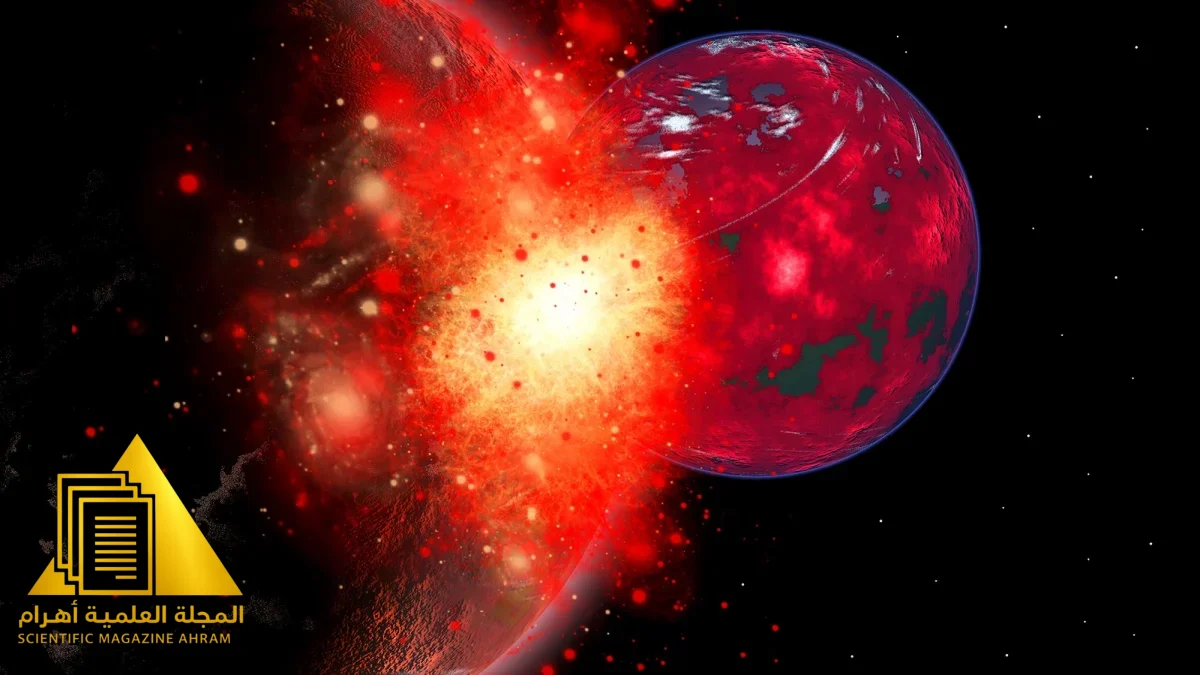

We have always been accustomed to looking at the giant planets in our solar system—Jupiter, Saturn, Uranus, and Neptune—as mighty guardians of the solar system, stable in their distant and secure orbits for billions of years. However, a recent astronomical study has revealed a frightening and surprising scenario, indicating that these giant planets may destroy one another in the distant future, and much faster than previously expected.
A Dark Future Awaits the Outer Planets
Computer models and new simulations run by astronomers indicate that the outer solar system will fall into utter chaos after the Sun exhausts its nuclear fuel and transforms into a white dwarf star. In the past, the prevailing belief was that the outer planets would mostly survive this phase and continue their quiet orbits. Yet newer calculations confirm that the Sun’s loss of mass will weaken its gravity, upsetting the delicate balance that maintains the stability of the orbits of these gas and ice giants.
A Dance of Chaos and Collision
As solar gravity begins to wane, the planets will gradually break free from their usual constraints, pushing them toward new and unexpected orbits. The simulations show that the mutual gravitational interplay among Jupiter, Saturn, Uranus, and Neptune will spark a series of chaotic interactions. Some of these planets may drift radically off course, and some may even be ejected entirely from the solar system, or destructive collisions may occur between them, redrawing the map of outer space in a catastrophic fashion.
A Shorter Time Window for the End
What is new in this study is not just the nature of the expected chaos, but its timing. It turns out that these orbital collapses will happen much sooner than previous estimates, just a few billion years after the Sun’s death. This discovery not only gives us a deeper look at the future of our cosmic home, but also reminds us that the universe is in constant motion, and that even the largest and most stable celestial structures carry the seeds of their own end.
By: Hany Sallam
Source: livescience.com


Latest video
تابع معنا تحليل قراءة الصحف اليومية مع الكاتب الصحفي Hany Sallam عبر