

Abdullah Saeed Al Habsi
When the Complaint About the System Ends and the Problem Remains
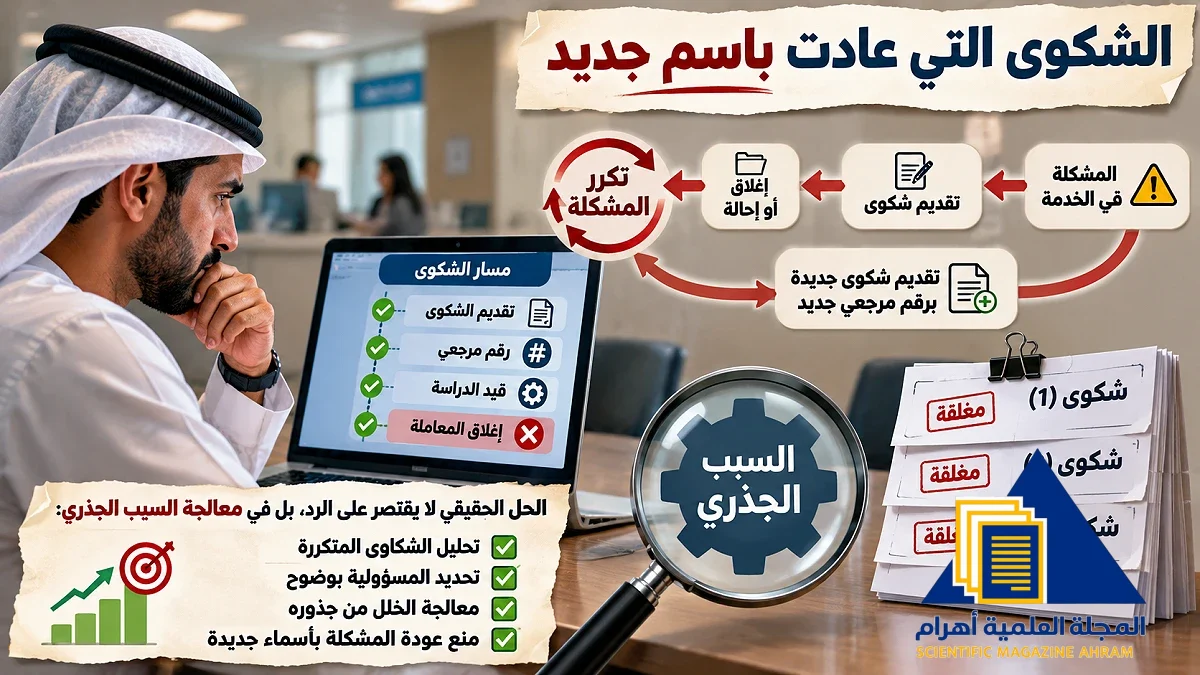
A citizen submits a complaint about a service glitch, receiving a reference number and a message stating that the request is under review. Days pass, then a brief reply arrives, indicating that the transaction has been closed or forwarded to another department. After a while, the exact same problem appears, forcing the person to file a new complaint as if nothing happened before. In reports, the first complaint may look finished, but in the life of the person who filed it, it has not ended.

This phenomenon deserves attention because it reveals a gap between managing complaints and managing the causes that produce them. Handling a customer well begins with replying to them, but it is not complete simply by replying. If the source of the glitch remains in place, the organization is not so much fixing the problem as recycling it between departments and channels.
Repeated Complaints Reveal a Larger Glitch
This can be observed in many services: a recurring outage, a procedure that stalls at a specific stage, incorrect information appearing repeatedly on screens, or an employee forced to correct data in the same way every week. Each report may be small on its own, but together the reports paint a larger picture of a glitch that needs an administrative decision or a technical adjustment.
Complaint Repetition Is an Indicator of Weak Root-Cause Mitigation
From a risk-management perspective, repeated complaints are an early indicator of weak root-cause mitigation. The question should not be limited to the number of reports closed during the month, but must include the number of problems that returned, the cost of their repetition to the customer and the organization, and the time it took to reach a solution that does not require the citizen to start over.
Performance Indicators and Departmental Responsibility
The problem may stem from the performance-evaluation method itself. If a team is rewarded for how quickly they close tickets, they will stay busy closing them even if they do not have the authority to address the cause. And if responsibilities are spread across different departments, no single department may feel responsible for the final outcome. Thus, the customer turns into an unofficial coordinator between entities, carrying transaction numbers and re-explaining the story over and over.
Measuring Real Impact Instead of Report-Closing Speed
The solution is not to cancel speed indicators or downplay the value of electronic replies, as those are useful tools. Rather, it is to supplement them with metrics connected to real impact: Did the service return to operation? Did the cause of the complaint disappear? Did the customer need to open another report? And did the organization review similar reports to learn from them instead of treating each one in isolation from the others?
A Clear Path for Escalation and Preserving Complaint History
It is likewise important to provide a clear path for escalation where the complainant does not have to retell the details every time. A digital system that retains the name and phone number should be capable of preserving the history of the problem and the decisions made regarding it, while protecting the privacy of its owner and making the information available to anyone who needs it to complete the handling process.
The Role of Employees in Spotting Recurring Complaints
Employees working in reception are an important source of information. They know the complaints that repeat in different wording, and they can point to the step where the solution stops. If they are allowed to raise these observations to someone who holds the power to change, the complaint becomes an opportunity to improve the service, not just an extra burden on the contact center.
Real Achievement Is Preventing the Problem from Repeating
An organization that uses a single complaint to prevent ten subsequent complaints achieves greater value than an organization that closes ten complaints and leaves their causes in place. Real achievement does not show in the color of an indicator on a dashboard, but in people’s lives after the problem ends.
It is not required for every system to be free of errors, as that is difficult to guarantee. What is required is that the same error does not return to the citizen every time under a new name and a new reference number.
Abdullah Saeed Al Habsi | Writer and researcher in security, heritage, risks, and operations rooms


Latest video
تابع معنا تحليل قراءة الصحف اليومية مع الكاتب الصحفي Hany Sallam عبر