


Do You Know the Web as Well as It Knows You?

By Mohamed El-Amin
Programmer and Graphic Designer
The Internet
This digital network has gradually surrounded us, particularly over the past three decades. It began as a form of entertainment and a way to pass free time, but we have become closely bound to it. It has penetrated every aspect of our daily activities—in play, serious work, joy, sorrow, and even the most intimate details of our personal lives, which flow into the giant database of the network.

No matter your age, occupation, or hobbies, you are already an internet user. Yet do you know the network as well as it knows you? This question needs to serve as an incentive to research the details of the network, the people responsible for it, and how it works.
Who Is Responsible for the Internet?
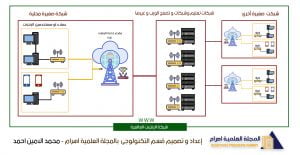
We cannot pinpoint a single person, organization, or even government that holds exclusive control and responsibility for the network. The answer to this question lies in how the network is described. Simply put, the internet consists of computers and database servers connected through routers to form smaller linked networks, such as educational networks, academic and research communities, web browsing, e-commerce, and social media networks. These smaller networks are then digitally linked to form the giant global World Wide Web (WWW). The following diagram illustrates the concept of the internet.

Consequently, if you trace who controls and is responsible for the internet, you will find that everyone who uses the network is responsible—including you. By using the network, you have become an influential and governing element of it. However, we need to understand that the management of the network takes place through regulatory laws established by international and national organizations to protect users, monitor content, and enforce other laws and standards that serve the public interest.
How the Internet Works
As a user, you interact through simple steps. For example, you open an internet browser, type in a website name, a research topic, or a book you want to reach, and click the search button. The final step is for the network to bring what you asked for onto your screen. What happens during these stages, and how? I will simplify it for you. If your computer is connected wired or wirelessly (Wi-Fi), you are connected to a small network created by your country’s internet service provider, of which you are a client. You carry a distinguishing address called an IP. Through this address, your internet service provider receives your message. In this case, the service provider acts as a small network, as we discussed earlier, and directs your message or request to other connected small networks—such as a digital library on the web. It searches its servers, which are simply computers dedicated to holding a large volume of data, finds what you requested, and delivers it to the service provider at its address, which in turn provides it to you via your own IP address.
Optimal Use
As we mentioned before, the network is deeply embedded in our lives. This brings many harms that we need to guard against, such as internet addiction and the loss of precious time with no real return. Through it, numerous instances of bullying occur, sometimes escalating into crimes such as the violation of personal privacy, information theft, piracy, and others. Therefore, we should exercise extreme caution when using the network and sharing our private data, and avoid abandoning real life—which is full of genuine social rewards—in exchange for digital emotions and an intangible virtual world. No matter how fond you are of using the network, treat it as a visitor and user, and do not cling to it.

References:
- ACM SIGCOMM Computer Communication ReviewVolume 14Issue 4October 1984 pp 11–17https://doi.org/10.1145/1024908.1024910.
- ean E. Kubeck (1999) FINDING INFORMATION ON THE WORLD WIDE WEB: EXPLORING OLDER ADULTS’ EXPLORATION, Educational Gerontology, 25:2, 167-183, DOI: 1080/036012799267945.
- Rong Wang1, Suzanne M. Bianchi2, Sara Raley3.(2005)Teenagers’ Internet Use and Family Rules: A Research Note


Latest video
تابع معنا تحليل قراءة الصحف اليومية مع الكاتب الصحفي Hany Sallam عبر