


Signs and Guide Markers: Early Alarms to Avoid Danger

By: Eng. Shaimaa Ashry Occupational Health and Safety Specialist
Signs and markers are a silent language, yet they are very direct and easily understood, spreading everywhere around us in this universe. They are the simplest language through which you can, dear reader, convey information or warn of a danger without needing further explanation. In my humble view, they are the most direct and fastest way ever to comprehend a situation and avoid a specific hazard. Yet, all of us still miss these messages sometimes, despite their extreme importance in each of our lives. In the workplace, however, the situation is completely different. Here, dear reader, you cannot ignore these signs; failing to understand these critical alerts can lead to disastrous situations, accidents, and injuries in which we might lose precious lives. While signs outside work may struggle to clarify issues, separate chaos from order, and define duties and responsibilities, the workplace must have a different, simplified, and cohesive approach to explaining these messages to avoid occupational hazards.
The Combined Objectives of Guide Signs: Warning of Danger and Explaining How to Handle It
One of the biggest responsibilities encountered in ensuring the activation of good signage is the ability of signs and markers to convey information. It is also necessary for every concerned person to understand the risks they are exposed to within their work environment and how they should deal with them. For this reason, placing appropriate signage in the workplace is essential, as it is one of the main reference points that achieve effective and direct communication with employees and workers. These signs must be found anywhere a potential hazard might exist, or where workers and employees are present. Their goal is not only to clarify the danger so it can be avoided, but also to explain the precautions that must be taken to avoid it. There are a large number of different signs in the workplace; many can be found in a particular spot, but all of them are important.
These signs can also convey a variety of meanings because, in many cases, a simple warning of danger is not enough. The best approach uses a full set of signs that not only help prevent dangerous situations, but also guide workers on how to handle them. For example, a hazardous gas sign might be accompanied by instructions to wear a gas mask, which is much more effective than a standalone warning symbol that would not explain how to avoid the potential danger.
This does not mean that one should rely solely on signs; there is no substitute for a properly trained workforce. Instead, signs should serve as a reminder and be useful for those who are not necessarily familiar with an area or process. For this reason, it is crucial that safety signs are easy to understand. Simple graphics or words work much better than complex instructions in allowing a person to make an immediate decision. Many can also be easily recognized, such as the red circular prohibition sign, but others may need to be more specific depending on the situation.

Main Types of Signs:
There is a set of main colors used in safety signs within the workplace, and color systems are usually the same worldwide. Red is an indicator of the potential presence of direct and severe danger, meaning that action must be taken or that something is indeed prohibited due to its extreme hazard. Yellow or orange is a warning that preventive and precautionary steps must be taken to avoid danger. Blue provides mandatory instructions and guidelines that often accompany danger or warning signs to ensure safety while carrying out various tasks. Green is a sign of safety and the disappearance of danger; it does not indicate any type of hazard, but is instead used to point to an escape route or a first-aid box. A workplace with a successful and effective health and safety system must use all of these types of signs. The presence of appropriate signage in your workplace can significantly reduce accidents, and most countries have existing legislation meaning that signage is legally required. Its absence exposes the location to violations, fines, and legal penalties that can sometimes reach the point of closing the workplace. Therefore, implementing a system of signs and markers is useful and necessary.

Very Important Signs at the Work Site (Key Signals):
Exit Sign:
In any workplace, the very first thing you need to look for is how to exit the premises in the event of any emergency or need to leave. Naturally, in every building or facility that complies with OSHA and NFPA regulations, you will find a clear set of exit signs indicating all safe exits. These must be kept free of any obstructions and be easily accessible, and every building or facility must have more than one safe exit.
Authorized Personnel Only (Unauthorized Entry Prohibited):
"Curiosity always kills the cat" is a true saying in most cases, and when it comes to workplace safety, it is 100% true. Therefore, there may be areas within a facility that must remain off-limits to the majority of workers, especially visitors, and should be considered accessible only to individuals with specific entry permits, authority, and credentials. The unauthorized entry sign clearly expresses this and is one of the mandatory signs in the workplace. Examples of such areas include hazardous chemical storage, radiation areas, and so on.
Personal Protective Equipment Sign:
When entering a work area with hazards that pose a threat, it is important to point to the appropriate precautions workers need to take before entering to protect themselves from harm. Such areas may include a construction site or workshops with rotating parts, slippery floors, compressed gas locations, and so on.
Flammable Material Sign:
In all places that may contain flammable materials such as fuel, there must be a sign indicating the risk of ignition and how to handle it. Examples of such places include fuel storage, compressed gas storage, chemical storage, and so on.
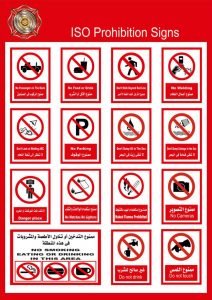
Biological Hazard Sign:
You can see the biological hazard sign in areas where harmful biological materials are present. Biological hazard signs are very common in hospitals and laboratories where body fluids, biological materials, bacteria, algae, and all kinds of organic material samples are handled, which can transmit germs to others if not handled and disposed of safely.
Electrical Safety Signs (Electrical Hazard):
The risk of electrical shock and the resulting injuries and fires accounts for 3 of the top 10 violations cited in OSHA records, and countless lives are lost every year due to improper practices when workers come into contact with electrically powered equipment and machinery.
This hazard is important and concerning, and signs and notices are an effective and impactful step in drawing attention to electrical hazards in the workplace.
Confined Space Entry Hazard Sign:
By definition, a confined space is not meant for continuous occupancy by workers. However, sometimes these are tight, poorly ventilated spaces with a single exit, occasionally deep and dimly lit, which often need to be entered to perform maintenance and other tasks. Confined space signs must be placed at entry points to alert workers that these areas and their associated tasks are only for workers who have been properly trained to work in confined spaces, and should only be entered by those with entry permits and after wearing appropriate protective equipment.
Slip and Fall Hazard Sign:
Slips and falls are among the most common accidents in various places, as well as the most costly when it comes to workplace safety injuries. All it takes is an uneven surface, a downward slope, or a misplaced obstacle in a passageway to cause a serious and very costly injury. Therefore, if there are known areas in the workplace where slips or near misses constantly occur, these signs should be posted and distributed appropriately.
Ultimately, we cannot solve the problem of workplace hazards simply by posting signs and instructions, but they are at least the first step toward activating a solid and coherent occupational health and safety management system. They provide clear hazard warning messages that may significantly limit the impact of these hazards, contributing to a sustainable safety strategy.

Next Topic: / Laboratory Safety
References:
- AS / NZS4360: 2009 Risk Management / Year = 2009, Australian Standards
- Risk Management – Risk Assessment Techniques – International Standard IEC / ISO 31010, ISO, 2011, p. 90
- How to Determine What Is Reasonably Practicable to Meet a Health and Safety Duty – Guidance Note – Safe Work Australia, May 2013
- Roughton, J. and Mercurio, J. (2002) “Developing an Effective Safety Culture: A Leadership Approach” http://emeetingplace.com/safetyblog/?page_id=8; ncsafetyandife.com. Butterworth-Heinemann
- Participant Guide (OSHA General Industry Program – High Trade Group for Occupational Safety and Health)
- Participant Guide (Risk Assessment and Mitigation Program)
- Egyptian Enterprise Development Program “Occupational Safety and Health”, August 2011


Latest video
تابع معنا تحليل قراءة الصحف اليومية مع الكاتب الصحفي Hany Sallam عبر