
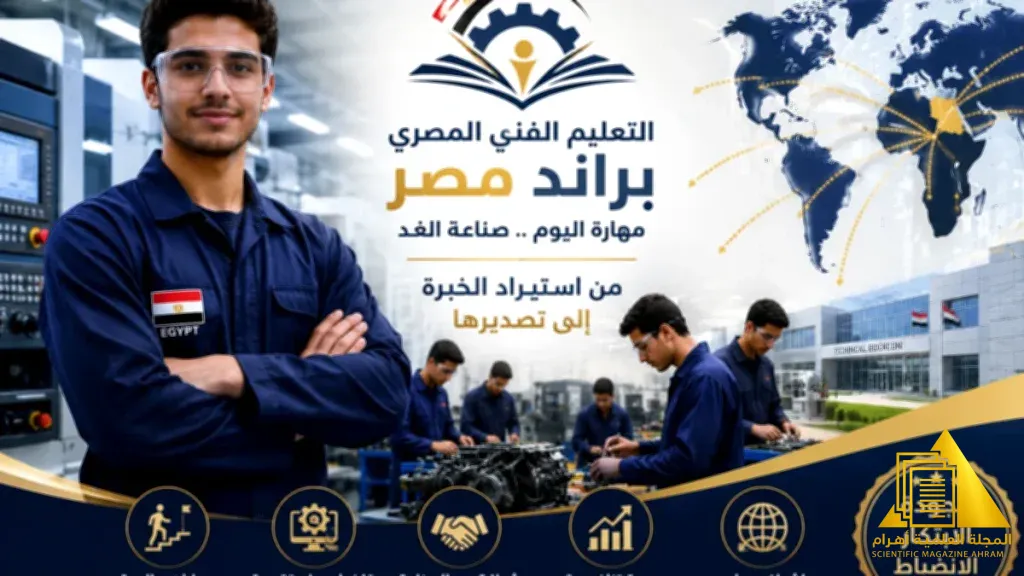

Egyptian Technical Education: From Dependency to Competitiveness (2)
Prepared by
Prof. Osama Maher Hussein – Professor at the National Center for Examinations and Educational Evaluation
Article Two: When Will We Build a Global Brand for Egyptian Technical Education?
When Will We Build a Global Brand for Egyptian Technical Education?
In the first article, I raised a question that was far from innocent: Do we teach students a trade… or do we train them on a machine?
The responses were numerous and varied, but all of them—supporters and critics alike—revolved around a single, larger question that nagged at me until it became an obsession: Why do we insist on remaining importers?
We import models. We import equipment. We even import terminology, then repackage it in Arabic and call it “development.” The question that deserves serious consideration is not: Where are we importing from this time? Rather: When will we build a model that is imported? When will Egypt transition from a country that seeks out expertise… to one that exports it?
This is not a dream. This is a national project
that has been delayed.
Egypt Has the Foundations, But Needs the Decision
Egypt does not lack foundations; rather, it lacks the decision. We have a rich history in technical education, millions of young people, a diverse industrial base, a geographical location that makes us a natural gateway to three continents, a broad Arab and African labor market, and Egyptian expertise spread across the world’s most demanding markets. All of these are raw elements. Raw elements alone do not make a brand. A brand is built when these elements turn into a single, cohesive story that can be exported.
Why shouldn’t “the Egyptian technician
” become a name that signifies quality, much as “Made in Germany” signifies precision and “Made in Japan” craftsmanship? Why shouldn’t our technical schools become a destination rather than just a transit station toward a certificate? Why do we continue to export the worker when we are capable of exporting the model that produced him?
Technical Education Is an Industry, Not Just an Educational File
The real problem does not lie in our capabilities, but in our mindset. For years, we viewed technical education as an internal educational file: schools, curricula, exams, and workshops. But the world redefined the landscape from beneath us. In advanced economies, technical education is no longer a “file”; it has become an industry in its own right—an industry that exports not only labor, but expertise, systems, and a complete training philosophy.
This is where Egypt must begin thinking about an entirely different project: the Egyptian technical education brand. A brand with an identity, philosophy, standards, certification systems, clear pathways, international partnerships, regional presence, and a genuine capacity to compete.
From Importing Models to Exporting Them
Instead of our highest ambition being to say, “We have a school operating on the Japanese system,” or “We have a school in cooperation with a European country,” we must reach the moment when we say, “We have an Egyptian model… and these countries are benefiting from it.” This is the difference between a student and a partner. Only here does true independence begin.
This does not mean closing our doors to the world; we need the world today more than ever. We need Japan to learn discipline and craftsmanship, Germany to learn how to build the bridge between education and industry, Italy to learn how skill marries creativity, and China to learn how education is managed on a large productive scale. However, the core difference is that the goal of cooperation should be to build our own self-capacity, not to perpetuate our dependency. We learn from everyone, and then we ask the question we have long evaded: What can we build ourselves?
The problem is not that our technical education benefits from global expertise; the problem is that we remain forever in the position of the recipient. We receive experts, we receive equipment, we receive curricula, and then we reproduce them with Arabic letters and call it an achievement.
When Will Egypt Become a Source of Technical Expertise?
When will we reach the moment when others come to us? When will an Arab or African expert say: I want to learn how you train the Egyptian technician? When will an Arab country send its students to our schools? When will we have a regional Egyptian center for qualifying technicians and trainers? When will the Egyptian professional certificate be recognized in the regional labor market the way German or Swiss certificates are? When do we start exporting expertise, not just workers?
These questions should trouble us, because the battle of the next decade will not be decided by owning factories alone, but by possessing the minds capable of operating and developing them. A country with skilled technicians possesses productive capacity. A country with productive capacity possesses an economy. And a country capable of training technicians efficiently is capable of exporting the skill itself, not just its output.
A Historic Opportunity for Egypt
Egypt has a rare historic opportunity here: to shift from exporting the worker to exporting the model that produces him. Why don’t we establish Egyptian training centers in Arab and African countries? Why don’t we offer qualification programs according to Egyptian standards with global quality, in industry, energy, technology, maintenance, industrial software, and artificial intelligence? Why won’t we soon have a phrase written on a training certificate in another country: “Made in Egypt”?
The goal is not a physical product, but an educational model that carries Egypt’s name, expertise, identity, and capacity for innovation.
The Private Sector as a Partner in Brand Building
Can the Ministry of Education alone build this brand? Frankly speaking, no.
This is where the private sector plays a pivotal role—not as a transient funder, but as a founding partner. We cannot build technical education that claims to compete with industry while industry itself is standing outside the decision-making room. Nor can we design programs within school walls and then ask a factory to “receive” a graduate whose training was never consulted.
The time has come to move past the notion that the private sector simply “receives” graduates after completion, and advance to a more mature idea: making it a partner in shaping them from day one. We need a genuine partnership among the Ministry of Technical Education, industry, universities, and professional bodies—a partnership that goes beyond signing a protocol, built instead on a clear division of roles. The school provides the scientific and technological foundation. Industry defines the skills actually required, not theoretical ones. The private sector participates in program design, curriculum updates, workshop equipping, on-the-job training in real work environments, and student assessment, positioning itself as the primary beneficiary of a graduate tailored to its actual needs.
Through this, the relationship shifts from “education graduates and industry receives” to “education and society craft the graduate together.” In my view, this is one of the most important keys to the Egyptian brand: having the private sector partner in quality, skill, training, assessment, employment, and results measurement, rather than merely waiting at the end of the line.
Indeed, every sector must have a direct voice in defining future skills. Automotive has its needs, energy has its needs, engineering industries have their needs, technology and artificial intelligence have theirs, and food industries and construction have their own specific requirements. The closer education gets to industry, the closer the graduate gets to the labor market. The higher the quality of the graduate, the higher the factory’s productivity. And the higher the factory’s productivity, the greater the competitiveness of the Egyptian economy.
The Equation of Success in Technical Education
These are not just rhetorical statements, but an equation that must become our compass:
Strong technical education → skilled technician → more productive industry → more competitive economy → stronger Egyptian brand.
Measuring Success by Numbers, Not Slogans
True brands are not built on rhetoric, but on numbers that withstand comparison. If we want to forge an Egyptian technical education brand, we must possess a rigorous national system to measure its success: What percentage of our graduates work in their specialty? What is their wage level? How satisfied are employers with their skills? How many can compete outside Egypt? To what extent are our professional certificates recognized regionally and internationally? And where does that place us in global skills and vocational training indices?
These indicators must not remain confined to official reports gathering dust on shelves. They must transform into a national dashboard that we monitor year after year, comparing ourselves against real competitors rather than our own performance last year, and tying funding and decisions to actual results rather than good intentions. Nations do not build their brands with slogans, but with performance that can be measured, compared, and exported.
Toward a New Egyptian Industry: The Skills Industry
The ultimate goal is for an Egyptian factory owner to say: “I look for an Egyptian technical education graduate because they are the best.” And for a factory owner in an Arab or African country to say: “I want an Egyptian graduate because they possess exactly what I need.” Only then will we have truly begun building a brand, rather than just talking about it.
Therefore, the private sector must not be reduced to funding a school or equipping a workshop; it must be a strategic partner in shaping policies and professional standards themselves. We need real models where major industrial institutions take responsibility for specific specialties, from curriculum building to practical training, assessment, and employment. We then move from the philosophy of “training for employment” to a deeper philosophy: “education for production and competitiveness.” A skilled graduate does not just open a door for themselves; they raise factory productivity, reduce the cost of error, improve product quality, expand export capacity, and attract new investment. In this sense, technical education becomes a direct part of Egypt’s economic battle, not a marginal add-on.
I hope to see, in the near future, partnerships whose ambitions do not stop at running a school or training a cohort of students, but extend to building an integrated model that is measurable, scalable, and exportable—a model we can stand before and say with confidence: This is Egyptian technical education. These are its skills. These are its standards. These are its certificates. These are its measurable results. And this is its value in the labor market.
We can then take this model to the Arab region and Africa, not merely to train their students, but to design their programs, qualify their trainers, build their training centers, and manage their skills systems. At that point, we will have created not only a brand for Egyptian technical education, but an entire new Egyptian industry: the skills industry. This may well be one of the most important industries with which Egypt can compete globally in the coming decade.
Conclusion: From Dependency to Competitiveness
However, this comes with one non-negotiable condition: that we stop treating technical education as a file subordinate to a department or ministry, and begin treating it as a national economic project—one that serves industry, cuts unemployment, raises productivity and competitiveness, opens new markets for young people, and makes Egypt a regional hub for skills rather than a distribution station for cheap labor.
The question worth asking today is not: with which country will we sign the next protocol? Rather: what do we want to build ourselves, with our own hands, for ourselves?
We need the world, yes. But the world also needs people who can operate, maintain, and develop its technology—it needs technicians, not slogans. Egypt is capable of being a key player in meeting this need, provided it possesses the vision and the will, that state efforts integrate with industry and the private sector, and that it stops viewing technical education as “alternative education” and begins treating it as one of its most important weapons in the battle for the future.
Indeed, the greatest thing Egypt exports in the coming years may not be a commodity, a product, or even a service. The greatest thing it exports may well be: the skilled Egyptian worker. If we succeed in making the name “Egyptian technician” synonymous with skill, discipline, mastery, and the ability to keep pace with technology, we will have created one of the most powerful Egyptian brands in the world.
Let us state it clearly and unambiguously: we do not want our technical education to be an improved copy of another country’s education. We want an authentic Egyptian model that learns from the world, competes with the world, and then teaches the world. We want to reach the day when no one asks: where did Egypt import its model from? Instead, they will ask: how did Egypt manage to build it itself?
Only then will we have truly moved: from dependence to competition. From importing expertise to exporting it. And from training our children to work in other people’s factories, to building a system that makes the world seek out our children.
And here… the “brand” of Egyptian technical education begins.


Latest video
تابع معنا تحليل قراءة الصحف اليومية مع الكاتب الصحفي Hany Sallam عبر