

Prepared by Prof. Magdy Farouk El-Samahy
These are carnivorous plants that derive most of their nutrition by consuming insects, luring them into a trap of enzymes that digest and absorb their nutrients. Such plants live in areas with abundant sunshine and infertile soil. There are many carnivorous plants in the world, with more than ten lineages divided into several species. They are more advanced than other plants; although they carry out photosynthesis, they possess organs that catch insects to obtain the nitrogen missing from poor soil.
The enzyme found in these plants helps digest protein and nucleic acids found in insects by releasing amino acids and phosphate ions. The first person to write about carnivorous (insect-eating) plants was Charles Darwin, who published his book in 1875 entitled Insectivorous Plants. Since that time, these plants have evolved significantly through stages until reaching more than 630 species.
Insect-Trapping Mechanisms:
There are five primary mechanisms in these plants:
- Pitcher Plants: These plants catch insects by luring them into the enzymatic liquid inside the leaf, drawing them toward its brightly colored flowers.
- Flypaper Plants: They catch insects using a sticky substance found on the leaves.
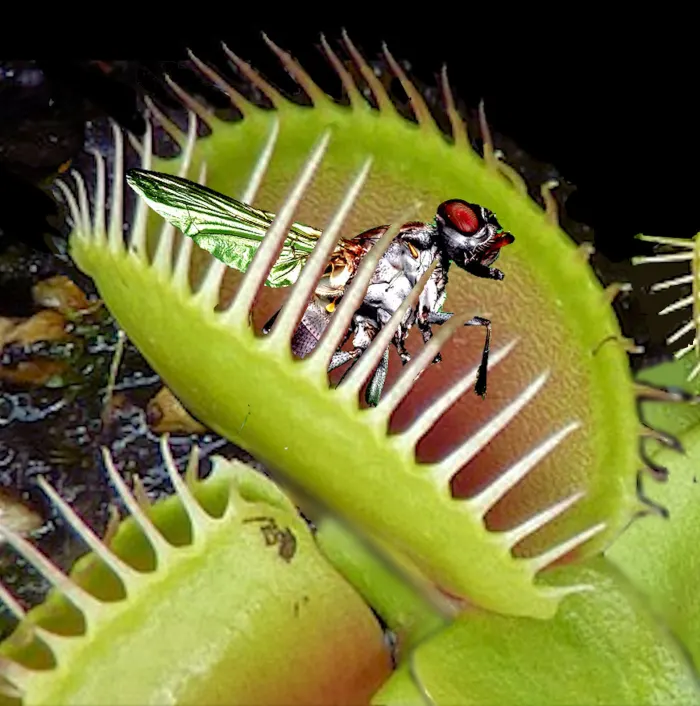
- Snap Trap Plants: When an insect lands on the leaf, it snaps shut quickly and digests it.
- Bladder Traps Plants: These plants feature a bladder with a small closed opening and sensors in front of it. When an insect lands near the bladder and hits those sensors, the opening opens and the plant pulls the insect inside.
- Crayfish Plants, also known as the eel trap: This plant forces insects to reach its digestive organ through its hairs.
Some Species of Insect-Catching Plants:
- Sarracenia: This plant grows in North America, Texas, the Great Lakes region, and also grows in southeastern Canada.
- Nepenthes: It grows in China, Malaysia, Indonesia, the Philippines, Australia, and Madagascar. This plant is called monkey cups because monkeys used to drink rainwater that collected inside them.
- Genlisea: There are twenty-one species of this plant, which sprouts in damp areas and grows in Africa, as well as Central and South America.

Prof. Magdy Farouk El-Samahy
Professor of Nanotechnology and Plant Protection – Plant Protection Research Institute – Agricultural Research Center
Coordinator of the Pesticide Applicators Program in Kafr El-Sheikh Governorate
Head of the Kafr El-Sheikh Branch of the Arab Union for Sustainable Development and Environment
Board Member of the Association of Egyptian Scientists Council
Member of the Scientific Research Ethics Committee at Kafrelsheikh University
Advisor to the Board of Directors of Ahram Science Magazine


Latest video
تابع معنا تحليل قراءة الصحف اليومية مع الكاتب الصحفي Hany Sallam عبر