

The Magical Touch of Technology

By Mohamed Al-Amin – Programmer and Graphic Designer
A magical touch of our fingers on a glass screen—whether on our mobile phones, computers, or ATMs—and your commands execute with precision. This makes you feel powerful and in step with modern times. We find this technology all around us, and whenever global companies want to win over customers who love progress, they replace their button-filled devices with these magical glass screens.

How Many of Us Know How?
Everyone boasts about owning advanced touch-enabled phones. Regardless of a user’s age or background, they have become expert users of this technology, which began many decades ago—specifically around 57 years ago. But how many of us know how these screens work? In my view, true power does not lie in being a good user of every development, but rather in understanding how that development works.
How Do Our Fingers Move the Screens?
I will explain this very simply; you do not need to be an expert in information technology to grasp how touchscreens work.
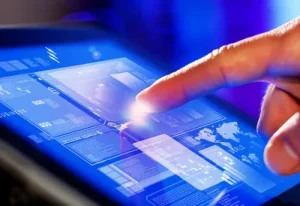
They are simply screens made of layers of glass and plastic, coated with an electrically conductive material such as tin oxide or copper. In this way, the screen acts as an electrically conductive medium. Like any electrical circuit, electricity only flows when the circuit is complete. In this case, the circuit completes at the point where your finger touches, which changes the electrical charge at that location, and your device registers this information as a “touch event.”
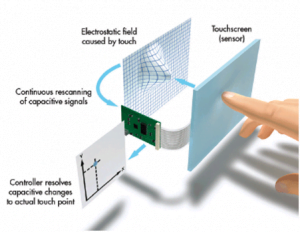
Behind this conductive glass lie screen receivers that record the touch event, causing the device to respond to your commands.
The Touchscreen Receiver Without Touch!
As I mentioned, this technology was invented decades ago, and we all know that progress does not stop. So what new development is expected to spread in this field?
Simply put, touchscreen technology will transform into displays that operate without the need for direct physical touch. This is not a prediction, but has already happened: a new patented technology developed by engineers at the University of Cambridge achieves precisely that.

They call this technology “predictive touch.” Using a combination of sensing technology and artificial intelligence, it predicts the user’s intended target and selects it before the user touches it.
The Magic of Technology
Technology has magic. I do not say this out of a love for this field, but because it is reality, and the future of touchscreens is proof of this.
This advanced technology uses a gesture tracker via a device that senses through machine vision, as if the machine sees you and executes your commands.
Not only that, but this technology also incorporates artificial intelligence containing information about the user and environmental conditions, alongside gaze-tracking technology to determine what the user intends to do.
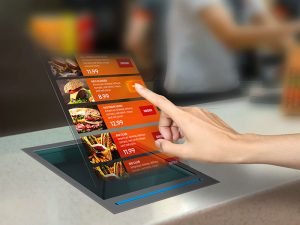
Since the screen will not be touched in this case, there will be no need for a physical screen at all; it will be replaced by holographic images that move as soon as you interact with them. Is this not magical?
I conclude my article by inviting everyone to prepare for what is to come, for the wheel of development and innovation will not stop. We will not participate effectively simply by using modern technologies; rather, we must all embrace a culture of knowledge, research, and flexibility toward the developments happening around us. This is the root of development and the beginning of becoming a driver of innovation rather than just a user.
References:
- Gary Barrett , Ryomei Omote (2010).” Projected-Capacitive Touch Technology” https://doi.org/10.1002/j.2637-496X.2010.tb00229.x
- Fundamentals of Touch Technologies and Applications Geoff Walker May 23, 2010.
- Official Research News Website of the University of Cambridge


Latest video
تابع معنا تحليل قراءة الصحف اليومية مع الكاتب الصحفي Hany Sallam عبر