

“Sustainable Recycling in the Circular Economy Toward a Green World”
By Chemist Marwa Khaled Shehab
“Recycling” may be a buzzword for an eco-friendly approach to waste management, but with current disposal methods threatening our environment and health, sustainable recycling preserves natural resources and reduces the damage they cause to the world.
The process of collecting waste and turning it into new, usable materials is called recycling. It is one of the eco-friendly ways to manage solid waste for a sustainable society, rather than sending it to landfills.
Recycling plays a key role in current standards of well-being. The new 21st-century era of sustainability is a major concern that has created the need for an alternative to traditional waste disposal, and sustainability is the key to a healthy environment and successful business.
Recycling Processes
Step One: Waste Collection and Processing
Waste is collected through specialized centers, and once gathered at the recycling plant, recyclable materials are sorted, cleaned, and processed into materials that can be used in manufacturing.
Step Two: Manufacturing
More and more of today’s products are manufactured with recycled content. Recycled materials are also used in new ways, such as reclaimed glass in asphalt for paving roads or reclaimed plastic in carpets and park benches.
Step Three: Buying new products made from recycled materials
The Final Step is also the step of initiative. As a society, we help close the continuous loop when we buy a recycled product. Furthermore, we help start the loop again by demanding one.
Increasing global consumption produces more waste, and higher production follows with an increased demand for recyclable materials. Making new aluminum from old products, such as recycled cans and foil, uses 95% less energy than making it from scratch. For steel, it saves about 70%. In addition, the energy saved by recycling a single glass bottle equals the electricity used to power an old 100-watt lightbulb for 4 hours, and much longer for an LED bulb. Isn’t this shocking!
One of the many benefits of recycling is that it reduces the amount of waste sent to landfills and incinerators. It is also economically beneficial because it creates jobs, as recycling activities require more labor than burning waste, according to Zero Waste Europe. Another benefit is the impact of recycling on the environment: by reducing the need for raw materials, it preserves finite natural resources such as timber, water, and metals. Recycling also prevents pollution and saves energy by reducing the need to collect, transport, and process raw materials.
Waste is an inevitable byproduct of most safety activities. To limit this negative element, we consider two ways to reduce the pollution inventory, recycling and disposal. The world produces 201 billion tons of municipal solid waste annually, and at least 40 to 50 percent of that is not managed in an environmentally safe setting. Egypt is the sixth largest country in the Arab World, with about 2 million tons of waste produced annually. Solid waste in Egypt consists of 56% organic matter, 13% plastic, 10% paper, 4% glass, 29% metals, and 15% other materials.
The Circular Economy Means Sustainability
The circular economy model fits directly into the general framework of sustainable development. It is part of a global strategy that also uses, among other things, the principles of the green economy, industrial ecology, ecodesign, or job economics.
The primary benefit of the circular economy is environmental protection, reducing waste and greenhouse gas emissions, regular recycling, and ending planned obsolescence. The circular economy also allows a reduction in dependence on imported resources (raw materials, water, and energy).
The phrase “circular economy” first appeared in the work of a few resource economists dating back to at least the 1980s. In recent years, its usage has come to denote a more systematic and ambitious approach than recycling. For example, to maintain quality, plastic bottle manufacturers need to mix recycled plastic with virgin materials. A truly circular economy, by contrast, would not involve any new material inputs at all, ultimately reducing emissions, waste, and costs. Some industries are already approaching this—for instance, almost all cars can be recovered. But others still have a long way to go: 97% of the materials used in clothing manufacturing are brand new, and 73% of these products are incinerated or sent to landfills. This is not an entirely new idea—the slogan “make do and mend” was popularized during World War II to encourage as little waste as possible.
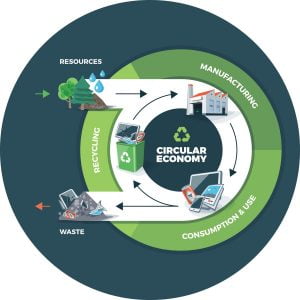
The circular economy is an attractive, clever, and innovative concept; it is a sustainable development strategy proposed to tackle the problems of environmental degradation and lessen the economy’s reliance on natural resources and the environment. By incorporating the 3R principles of material use—Reduce, Reuse, and Recycle—into the production and consumption process, the circular economy aims to increase resource productivity, boost energy savings, and reduce greenhouse gas emissions. The circular economy reduces material use, redesigns materials, products, and services to be less resource-intensive, and recovers “waste” as a resource to manufacture new materials and products. Recovering products and components and reusing materials for recycling purposes promotes sustainable development because it decreases the need to use precious natural resources and raw materials.
Recycling is a key component of modern waste reduction and is the third element in the hierarchy of reducing waste, reusing, and recycling. For a recycling program to succeed, providing a large and stable supply of recyclable materials is crucial.
The principle of reducing waste, reusing, and recycling resources and products is often called the “3R’s”.
Reduce: choosing to use items carefully to minimize the amount of waste generated.
Reuse: the repeated use of items or parts of items that still have usable aspects.
Recycle: using waste itself as a resource. Waste reduction can be achieved effectively by focusing primarily on the first three processes, “reduce,” followed by “reuse,” and then “recycle.”
A waste-free world: Over the past decade, a new term has emerged in the world of waste. It is called zero waste, meaning we value all resources and waste nothing. While this still encourages waste reduction, lower consumption, and recycling, there is also a push on industry to make products that can be reused, repaired, recycled, or composted.
The Zero Waste International Alliance definition of zero waste is:
“Zero waste is an ethical, economical, efficient, and visionary goal to guide people in changing their lifestyles and practices to emulate sustainable natural cycles, where all discarded materials are designed to become resources for others to use. Zero waste means designing and managing products and processes to systematically avoid and eliminate the volume and toxicity of waste and materials, conserve and recover all resources, and not burn or bury them.”
The 3R concept has been transformed into 5Rs or zero waste (“zero loss”). The New Zealand Zero Waste Network states that applying zero waste will eliminate all discharges to land, water, or air that pose a threat to planetary, human, animal, or plant health.
The 5 R’s of Waste Management
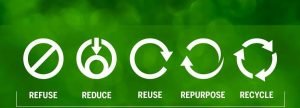
According to the 5 R’s, four actions should be taken, if possible, before “recycling”: Refuse, which is the first element in the 5R hierarchy. Learning to refuse waste may require some practice, but integrating this step into a business strategy is the most effective way to minimize waste; then Reduce; Reuse; Repurpose—for every item that cannot be refused, reduced, or reused, try to repurpose it. Many people in the green community refer to this method as upcycling; and finally, Recycle. Incorporating this methodology into your waste reduction and recycling efforts will minimize landfill waste and help take your recycling program to the next level.
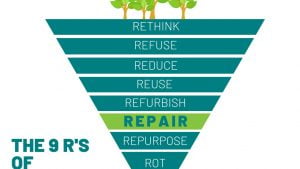
9R’s of Waste Management
The framework consists of nine parts starting at the top of the conceptual hierarchy with rethink, providing useful tips and data down to the final and least preferred option before throwing something in the trash, which is recycling.
The nine parts begin at the top of the pyramid with “Rethink”—which means considering what waste is and how to reduce its environmental impact—followed by “Refuse,” “Reduce,” “Reuse,” “Refurbish” (restoring and updating an old product), “Repair” (fixing and servicing a defective product so it can be used for its original function), “Repurpose,” and “Rot.” In a zero-waste, circular community, all materials used remain in the loop. Everything that leaves the system becomes compost and everything else stays. Nothing is burned in an incinerator or stored in a landfill.
These inverted pyramids help shape people’s actions and prioritize them. The higher the action is on the list, the more likely it is to take you in the right direction. It is a set of hierarchical steps aimed at managing waste in a more sustainable manner, forming a type of waste hierarchy.
The steps that appear first, or at the beginning, are usually steps that should be followed before recycling or disposing of waste.
In this context, recycling is one of the most important processes that needs to be highlighted in reducing post-consumer waste, alongside the need to research and develop recycling as a tool for environmental protection. It is also important to consider that the green circular economy is a way to achieve sustainable development, optimize waste recycling, and adopt the recovery and municipal waste industries as new targets for economic growth.
References
- 3rs – reduce, Reuse & Recycle. SustainableSA.com. (2016, August 2). Retrieved October 26, 2022, from https://www.sustainablesanantonio.com/practices-technology/reduce-reuse-recycle/
- Environmental Protection Agency. (n.d.). Recycling Basics. EPA. Retrieved October 26, 2022, from https://www.epa.gov/recycle/recycling-basics
- Environmental Protection Agency. (n.d.). EPA. Retrieved October 26, 2022, from https://www.epa.gov/recyclingstrategy/what-circular-economy
- Mohammed, M., Shafiq, N., Abdallah, N. A. W., Ayoub, M., & Haruna, A. (2020, April). A review on achieving sustainable construction waste management through application of 3R (reduction, reuse, recycling): A lifecycle approach. In IOP Conference Series: Earth and Environmental Science(Vol. 476, No. 1, p. 012010). IOP Publishing.
- Stewart, R., & Niero, M. (2018). Circular economy in corporate sustainability strategies: A review of corporate sustainability reports in the fast‐moving consumer goods sector. Business Strategy and the Environment, 27(7), 1005-1022.


Latest video
تابع معنا تحليل قراءة الصحف اليومية مع الكاتب الصحفي Hany Sallam عبر