
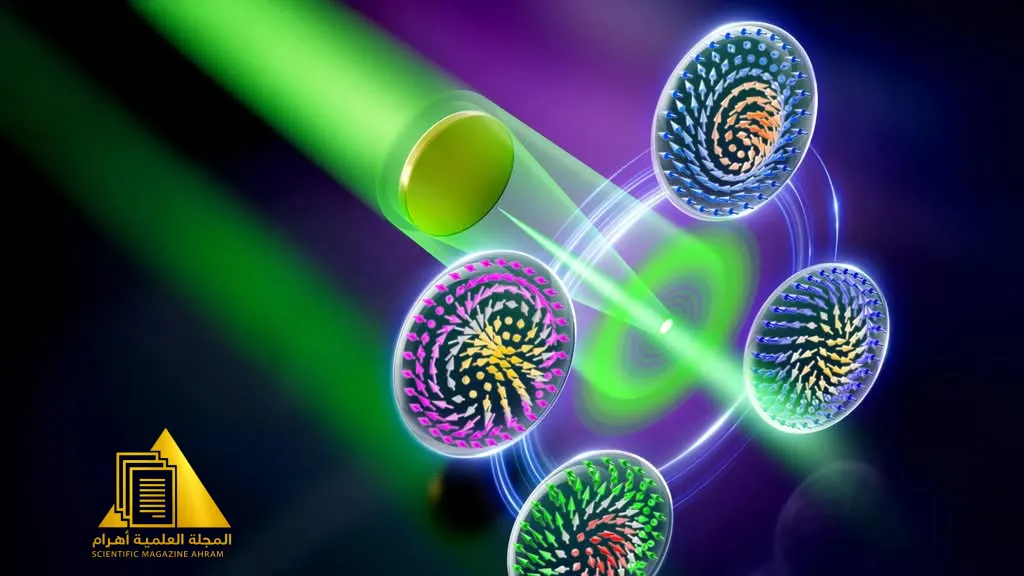

At an intriguing intersection of physics history and future technology, a team of scientists at Nanyang Technological University in Singapore has successfully revived a classical optical phenomenon that is two centuries old. This discovery is not merely a theoretical academic achievement; it wide opens the door to an anticipated technological revolution that may completely change the face of the computers, communication networks, and data storage systems we rely on in our daily lives.
The Secret of Poisson’s Spot and the Nineteenth-Century Challenge
The story begins with a famous physical effect known as “Poisson’s spot,” an experimental phenomenon used in the early nineteenth century to settle the debate over the wave nature of light. The core idea is that when a beam of light is shone onto an opaque circular disk, light waves bend around the edges of the disk and interfere on the other side to form a bright glowing spot precisely in the middle of the shadow region. Scientists of that era considered this simple effect a mere physical proof, but today, in the hands of researchers, it has turned into a tool for producing highly complex optical structures without the need for intricate technologies.
Optical Skyrmions: Ultra-Stable Vortices of the Future
Through this historical experiment, the researchers managed to invent a method for producing what are known as “optical skyrmions.” Skyrmions are quasiparticles that take the shape of minuscule magnetic light vortices with a unique geometric cohesion. The importance of these optical vortices lies in their high flexibility and exceptional stability. They can maintain their structural cohesion even when traveling across long distances or encountering interfering obstacles, making them ideal and secure carriers for transmitting and storing digital information.
Extreme Simplicity Outperforming Expensive Materials
Before this achievement, producing these optical vortices required the use of precise engineered materials that were both financially costly and complex to manufacture. However, the new innovation presented by the scientists in Singapore lies in completely dispensing with those complications. By simply shining a conventional laser onto a simple microscopic circular disk, these optical skyrmions are generated automatically and with astonishing stability thanks to the interference of Poisson’s spot. This unexpected simplicity means these components can be manufactured on a wide commercial scale at the lowest possible cost.
Promising Horizons in Computing and Communications
The ability to produce optical skyrmions with such ease opens unprecedented horizons for the world of computing. In the near future, computers may rely entirely on light instead of electrons, meaning ultra-fast processing speeds and near-zero energy consumption. In addition, this technology will allow
vast amounts of data to be stored in tiny spaces thanks to the stability of these vortices, alongside developing encrypted optical communication networks that are impervious to hacking, heralding a new era of information security and blistering speeds.
By: Hany Sallam
Source: ScienceDaily


Latest video
تابع معنا تحليل قراءة الصحف اليومية مع الكاتب الصحفي Hany Sallam عبر