
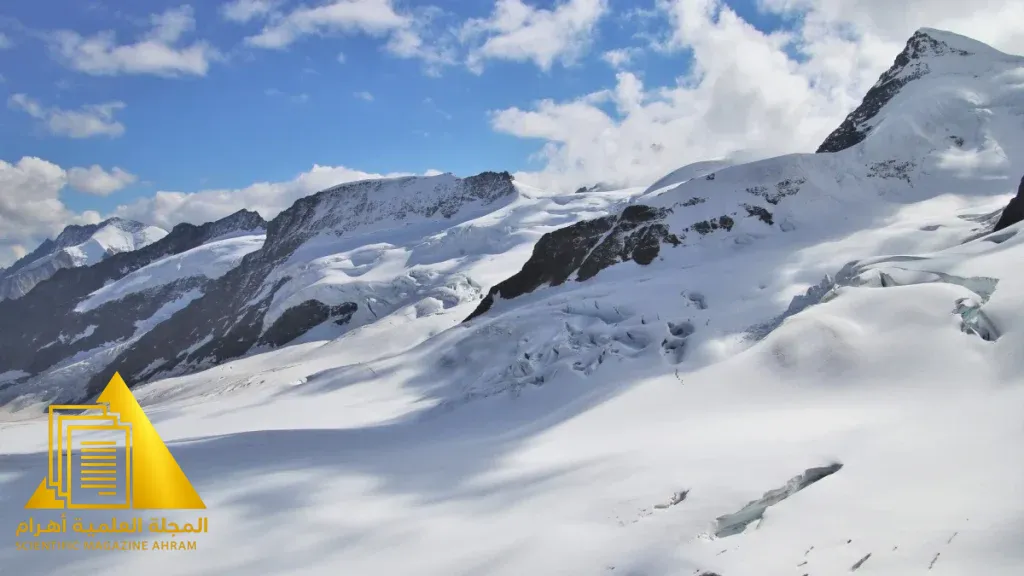

New Climate Model Reveals Secrets of Glacier Melting
For a long time, scientists relied on annual average temperatures in their projections for the future of glaciers, but a recent study by researchers from Switzerland and Belgium has turned the tables. The study proved that ignoring ‘daily weather fluctuations’ made our previous melting models less accurate, which led us to reconsider the speed at which giant ice masses are disappearing around the world.
Heatwaves: The Hidden Driver of Glacier Melting
The recently published study indicates that short-term weather events, such as the exceptional heatwaves we have witnessed in recent years, play a pivotal role that is not accurately captured through annual averages. When temperatures rise sharply and suddenly, ice does not melt at simple linear rates; rather, the pace of its loss accelerates beyond traditional expectations, meaning that glacial ecosystems are more sensitive to extreme weather than we used to think.
Sea Level Rise: A Threat to Coasts
Integrating these daily variables into computer simulations has provided a more realistic and harsh picture of our planet’s future. The results indicate that we are facing a faster rise in sea levels by the end of this century. This rise does not merely represent numbers in scientific studies; it is an alarm bell for coastal cities and communities living on the front lines with the oceans, as the accelerated melting of glaciers will reshape the global geographical map in an unprecedented way.
The Need to Act Before It Is Too Late
These findings place us before a major scientific and climate responsibility. Understanding the complex dynamics of glacier melting is not an academic luxury, but a necessary tool for decision-makers to develop more effective adaptation strategies. Advances in the accuracy of climate models give us the opportunity to see the future more clearly, which requires a rapid global response to curb the climate changes that fuel these extreme phenomena. The survival of ice means the survival of the balance of life on Earth as we know it.
By: Hany Sallam
Source: phys.org


Latest video
تابع معنا تحليل قراءة الصحف اليومية مع الكاتب الصحفي Hany Sallam عبر