
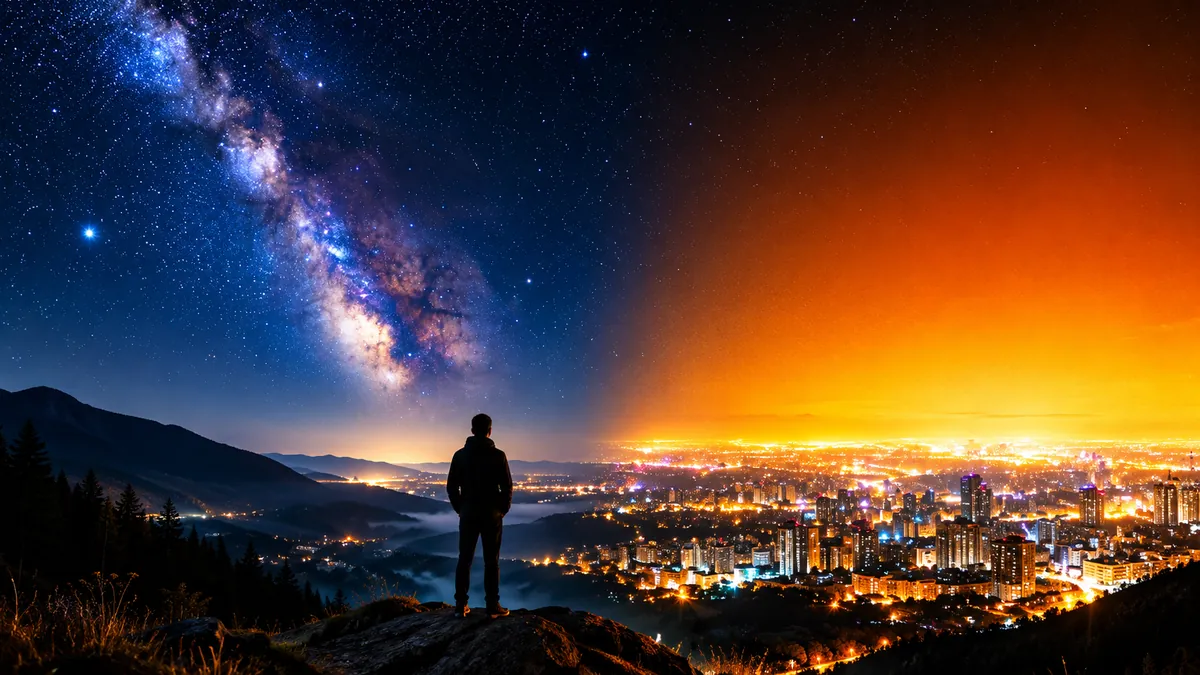

Centuries ago, the night was completely different from what we know today. When the sun went down, the sky filled with thousands of bright stars, and the Milky Way stretched across the heavens like a massive silver river from one side to the other.
Today, however, people in many cities around the world see only a handful of stars. The ancient sky has quietly vanished, replaced by a washed-out canopy flooded with artificial light.
This is “light pollution”—one of the modern changes that has altered humanity’s relationship with the night almost without anyone noticing.
When the Night Was Part of Human Life
Ancient civilizations lived for thousands of years under a dark, clear sky. People relied on the stars for travel, agriculture, tracking the seasons, and navigation.
Even stories and myths were born from watching the sky. Humans imagined shapes and tales among the stars, creating the constellation names we still know today.
The night itself carried a deep sense of calm and awe because the sky felt closer and more present in people’s lives.
How the Stars Disappeared
With the expansion of modern cities, artificial light began spreading everywhere. Illuminated streets, billboards, city towers, stadiums, and giant buildings all cast massive amounts of light up into the sky.
When this light scatters in the atmosphere, it turns the night into a luminous haze that hides fainter stars.
For this reason, residents of deserts and remote areas can still see a breathtaking, star-filled sky, while people in major cities cannot see most of them.
A Generation That Has Never Seen the Milky Way
Numerous studies indicate that millions of people around the world have never seen the Milky Way with their own eyes.
That may sound strange, given that the galaxy was a natural, familiar sight to humans for thousands of years.
Yet in modern cities, urban glare has grown stronger than the distant light of the galaxy, gradually erasing that celestial river from human life.
The Night That Lost Its Quiet
Light pollution does not affect only the stars; its impact extends to nature and humans as well.
Many birds and insects rely on the darkness of night to migrate, reproduce, or navigate. Research also indicates that constant nighttime light may affect human sleep and biological clocks.
With the loss of natural darkness, the night has lost a piece of the ancient calm that humans lived with for so long.
Places Still Guarding the Sky
Despite all this, a few places around certain parts of the world still preserve their natural darkness. In some deserts, mountains, and astronomical reserves, people can see the sky just as the ancients did.
There, far from cities and noise, the stars reappear in striking density, as if the universe is recovering its ancient voice once more.
Longing for the Ancient Sky
Perhaps this is why many people feel amazed when they first leave city lights behind and lift their eyes toward a dark sky.
The stars that disappeared never actually left the universe; they are simply hidden behind the light we created.
Perhaps this serves as a gentle reminder that no matter how crowded our cities become with lights, humans still search deep within themselves for that ancient sky that has accompanied our story from the very beginning.
Hany Sallam


Latest video
تابع معنا تحليل قراءة الصحف اليومية مع الكاتب الصحفي Hany Sallam عبر