
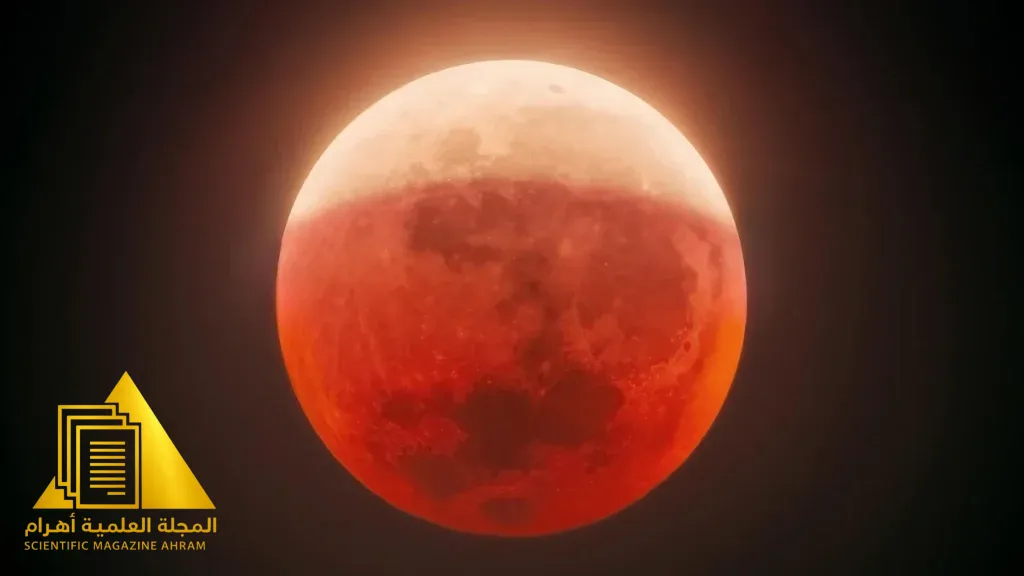

A Cosmic Symphony: The Moon Wears a Crimson Robe on August 28
In a date with beauty and mystery, the skies of the United Kingdom are preparing to welcome an exceptional astronomical phenomenon on August 28, as residents witness a partial lunar eclipse
that gives it a unique visual character, turning its usual silver disk into a deep reddish hue in a scene that combines the precision of celestial mechanics with the magic of open space.
Behind the Phenomenon: How Does the Moon Change Color?
An eclipse occurs when the Earth aligns between the Sun and the Moon, casting its shadow onto its lunar satellite. In a partial eclipse, the Earth’s shadow does not cover the entire lunar disk, but rather carves out a portion of it. The secret behind the striking color shift toward red lies in Earth’s atmosphere, where air molecules act as a filter that scatters blue and green light spectrums, while allowing lower-energy red wavelengths to pass through and refract toward the lunar surface—a process known scientifically as Rayleigh scattering.
An Unmissable Opportunity for Astronomy Enthusiasts
This event is a rare opportunity for stargazers and those interested in cosmic phenomena to observe the movement of celestial bodies closely. Unlike a solar eclipse, which requires special eye protection, a lunar eclipse is a completely safe visual experience that can be enjoyed with the naked eye without any complex equipment. It is an ideal moment to reflect on the precise cosmic harmony that governs our movement amidst this vast universe.
Tips for Observing the Eclipse
To get the best viewing experience for this phenomenon, experts advise choosing a location far from urban light pollution and finding a clear view toward the horizon. Although a partial eclipse may not last as long as a total eclipse, the gradual change in the Moon’s colors and the shifting gradients of shadow covering its craters provide photographers and amateurs with an unforgettable sight. Have your cameras ready, for the sky is set for a show that will not be easily forgotten.
By: Hany Sallam
Source: BBC Science


Latest video
تابع معنا تحليل قراءة الصحف اليومية مع الكاتب الصحفي Hany Sallam عبر