
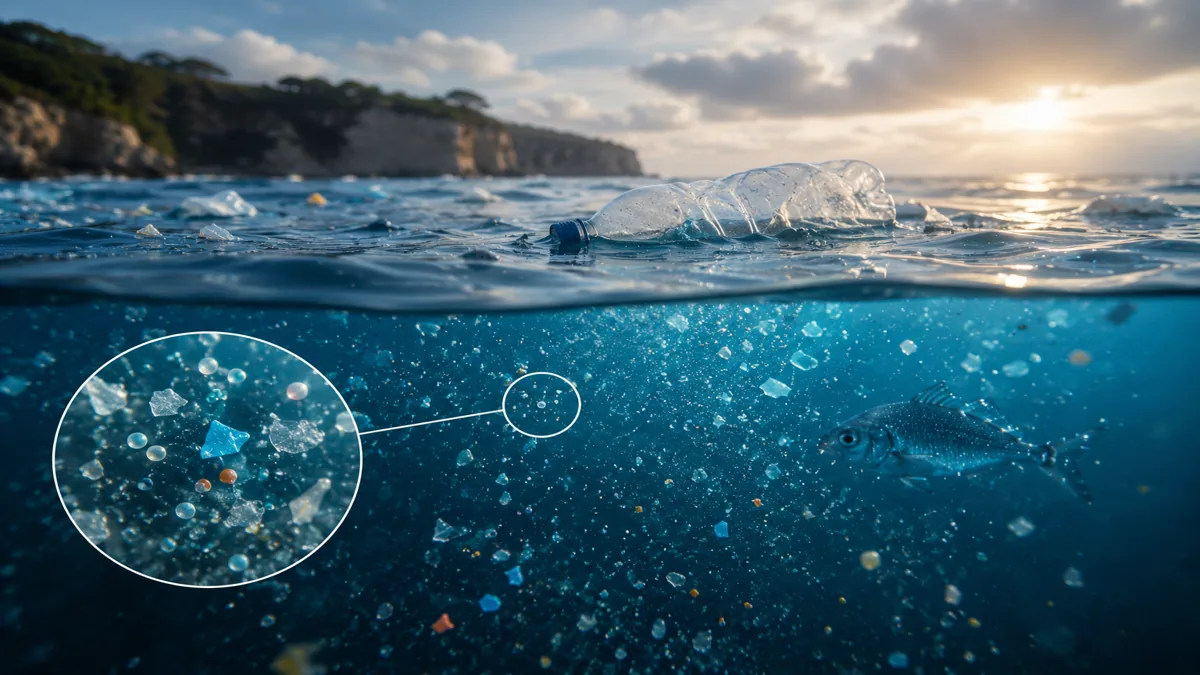

Marine ecologists have made a startling discovery that may change the world’s understanding of the plastic pollution crisis. A recent study reveals that massive quantities of plastic that disappeared from the oceans over past decades did not completely break down, but instead turned into microscopic nanoparticles that are now spreading through water, air, and living organisms.
Where Did the Plastic Disappear To?
For years, scientists tried to explain the disappearance of millions of tons of plastic entering the oceans, but they were only able to find a small fraction of it on the water’s surface.
However, the new study shows that most of this plastic did not actually vanish; rather, it broke apart into minuscule nanoparticles that are difficult to detect using traditional methods.
Particles Too Small to See
Researchers explained that these particles are thousands of times smaller than the width of a human hair. Consequently, they can easily move through ocean currents, the air, and even inside the bodies of living organisms.
Scientists have also detected these particles in:
Ocean waters
Marine air
Marine life
Polar ice
And even inside the human body in some previous studies
Researchers warn that nanoplastics may carry more severe environmental and health impacts than large pieces of plastic because they can infiltrate living cells and tissues much more easily.
A New Environmental Crisis
Environmental experts believe that the new discovery reveals an invisible dimension of the global pollution crisis. Instead of plastic merely accumulating on beaches, a huge portion of it is now spreading at a microscopic level within ecosystems.
At the same time, scientists fear that these fine particles could affect:
The marine food chain
Water quality
The health of marine life
The global climate
Future human health
Why Does the News Interest Scientists?
This study ranks among the most important recent environmental studies because it may finally explain the mystery of “missing plastic” that has baffled scientists for many years.
Researchers also believe the new findings may prompt global governments to tighten regulations concerning single-use plastics and accelerate the development of biodegradable materials.
Hany Sallam


Latest video
تابع معنا تحليل قراءة الصحف اليومية مع الكاتب الصحفي Hany Sallam عبر